A Word is a Word is a Word

Forewarning: This post may seem unbecoming coming from clergy, but we are not your grandmother’s clergy! Do not fear, be brave!

The title of this blog may seem familiar to some of you. Not because you have heard it before, but because it sounds like Gertrude Stein’s “a rose is a rose is a rose”. That is intentional. This line of Stein’s verse is famous in American/Modern poetry because it points out the hypocrisy of language in the modern and post modern era. In fact, Stein’s words want us to see that so much of what we make words to express is sometimes not what we mean at all and sometimes exactly what we mean. Hmmm…what? Yes in the modern and post-modern world we live with words that both say exactly what they mean and not at all what they mean–all at the same time. And we wonder why our society sometimes seems so crazy! We seem to live in a world that wants to reject the basic theological and religious principles of the “both / and” while at the same time society promotes dual meanings of so many things.

We used to live in a world where the social rules were clear and people more or less knew what was expected of them. The black and white time of knowing what was acceptable when and where–is no more, yes even before I was born we moved into the Technicolor age! The time when people both understood that others expected to be treated according to the Golden Rule and one might expect to be treated according to the Golden Rule is gone. We do not even know what to expect of our own language in such a twisted age. Or do we?

This has all been on my mind as I serve as a chaplain in multiple places. We often forget that our world is now in color rather than black or white. In some cases it is more shocking for those I meet to realize that I am an honest authentic human being then it is for them to accept that I am female and clergy! Several times in the past few months I have over heard people speaking plainly and honestly, letting the four letter words fly. But then they suddenly realize I am near by and I hear the refrain “We gotta be good, the chaplain is here”. Nothing makes me laugh more! Really, are they afraid of me? But inside it makes me sad for those I serve with and for myself. It makes me sad that individuals feel a need to censor their most authentic self as unfitting to being in the presence of those human beings who have been set aside as God’s servants. Occasionally in fulfilling priestly duties clergy may fulfill the role of the representative of God for portions of the liturgy, but clergy people are not God! Confusing clergy, in all they do, with actual representatives of God can be catastrophic, as I learned in my grandfather’s church.

In my years of chaplaincy, I have had my share of encounters in which I have heard many a swear word, not in a profane way but in an honest–there are no other words for this kind of way! I learned much and walked away from a particular encounter with great respect for an individual who in the face of power was authentically and piercingly honest even when every other word that had to be said was a swear word. I mean, when you get to down to the bones of it isn’t God, God’self a rather honestly authentic but there are no other words to describe it kind of being?

So, please do not feel the need to censor yourself around me. Really I am big woman, I can deal with it and I am not gonna judge anyone’s swearing (I feel differently about language that defames or degrades human beings). There is no need to pretend you don’t use the four letter words simply because I am around. I like four letter words–they can be theological. After all have you ever heard clergy talk amongst themselves when they think no one is listening? Besides, LOVE, is also a four letter word. Let’s be real, a word is a word, is a word. Except for that one Word from which all others spring.

Happy Eid ul Fitr!

Happy Eid ul Fitr everyone! Yes, this is the day that Muslims around the world celebrate the end of the holy month of Ramadan. Ramadan is a month of fasting from sun up to sun down and making alms to the poor. The Interfaith Calendar says Eid ul Fitr is “a festival of thanksgiving to Allah for enjoying the month of Ramadan. It involves wearing finest clothing, saying prayers, and fostering understanding with other religions.” (accessed August 31, 2011).

Fostering understanding between the world’s religions is something we at WWSIC can really support.

And, yes, as a chaplain Eid ul Fitr is one of those holidays a chaplain serving people of all faiths and no faiths needs to know about… So…

Blessings this Holy Day and may the God of Many Names Bless your feast this day and all days!

AWESOME!

Just saw this video on ucc.org and got goose bumps, so I had to share it.

Presence and Praying for Peace

Two nights ago I attended a candlelight vigil, I had received a text message about it earlier in the day and knew only that a man had been beaten. The text cam from my husband who had heard about this through his volunteer/community ties. From the context of the message I received I suspected hate of some form had to with the beating. I did not have much to go on, but I was moved enough to go to the vigil, and to wear my vestments, although no one had asked me to.

When I arrived at the vigil it was a small gathering and this surprised me, but not for long. I soon found the “organizer” of the event and spoke with him. It turns out that the man who had been beaten, Jason, had been living in a local canyon and someone had beaten him in the head with a rock. No words were said at the vigil no statements made or prayers pronounced. Rather people stood around and talked quietly with others that they knew as they held candles, while Jason fought for his life in the hospital. Many the people gathered knew Jason, some were from the local GLBT community. It was simply a gathering of solidarity.

Shortly after I arrived I was approached by a man in a collar. Turns out this man who spoke with me was a gay Independent American Catholic priest who had left the Roman Catholic Church disheartened by what appeared to be the Catholic Church’s refusal or inability to protect victims of the sexual abuse scandal. The priest reported to me that he was there because he knew Jason; the priest explained that he had met Jason while teaching in the local community. Both the priest and I were there simply to show our solidarity with the victim of this senseless crime and his chosen family, as Jason lay in a hospital bed, reportedly, with a very poor prognosis. We were there to provide presence to those who had gathered; all those who had gathered had gathered to be present.

Later in the evening a group of people came out of the hospital and physically leaned on some of those who had gathered for the vigil. They were Jason’s chosen family. One of the women in this group spoke with me and thanked me for being there. I did not do anything, but I was there. It was a reminder for me of how powerful our simple presence can be for others in time of crises.

So what about the vestments? I thought about this, particularly as the media came in and took pictures of the gathering. It may seem presumptuous, and perhaps it could be seen as such. At moments I felt a bit odd standing there, holding a candle in my clergy robe. But it was not presumptuous. It was not presumptuous because in many ways this event was the parable of the good Samaritan made real in the contemporary context. Here was a man and his extended community in crises and of course it was the role of the clergy to stop and bear witness to the pain of the other in crises. I was not there to fix anything I could not do that. But I could bear witness.

That is not the only reason I was there, though. We live in a society of great violence and marginalization of the poor, the GLBT community, the disability community, those who live with mental illness, those who struggle with addiction or propensity toward violence, and anyone else who steps beyond our norms. The truth is I do not know if Jason belonged to any of these categories expect being poor–he was living in the canyon. I do know, however, that we can not continue to accept senseless and extreme violence toward others within our community and continue to consider our society civilized, period. So I wore my vestments to show that God is with all who suffer, and that the marginalized are noticed by the communities who seek to bring God into the world. I wore my vestments, and I was there silently witnessing the suffering senseless violence perpetrates on its victims and on the community around the victims of violence. I did not offer to pray and I was not asked to pray; Jason’s family told the reporter who covered the “story” they were praying for his recovery. It was a gathering of presence and silent prayer. My prayer was one of peace not only for Jason, but for the community immediately around him, and our larger community that has become so fractured that such violence can occur without community uproar but rather be noted on the evening news before we all tuck into bed for a brief night’s sleep. God help us all.
A photo of  Jason, a homeless man who was beaten in the head with a rock, a candlelight vigil held in his honor.

Why That Color?

You may have noticed that the backdrop of our site has been changing periodically. This is not because we are simply bored, or even just in a flurry of redecorating. We have been changing the background of this site to reflect the liturgical colors of the Christian Year. Not all churches do this, I know, but many do and we thought it would be fun to do on this site as well. If you have ever noticed the seasonal changes in Creation well, then you know that God likes to redecorate from time to time–and so do we here at WWSIC!

The green is up for Ordinary Time, hope you like it. It will be here for a while.

United Church of Christ Disability Ministry Board—new member is also a WWSIC!

Today I got word that I have been invited (or is elected the word?) to join the Board of the United Church of Christ’s Disability Ministry! Something like this has been on my mind for a few years now so when I was approached and asked if I would be interested my response was “ABSOLUTELY!!” I’d been waiting for it. Now all that being said, I don’t have all the details on this new position, yet.

Nonetheless, I am excited to further the work of inclusion and access for people with disability within the UCC and to work with the UCC Mental Illness Network. I have been working with some of these folks on the Widening the Welcome 2, disability ministry conference planning team this year, so I know I will be working with some wonderful people! So excited!

Since presenting a workshop on Accessibility to All (A2A) at Southern California Nevada Conference of the UCC Annual Gathering two weeks ago, I have been thinking about how to differentiate and express the specific inclusion needs of people with disability as distinct from “Open and Affirming” (ONA).  I have been thinking this because I spoke with a pastor at AG who did not see the need to become A2A because the congregation was ONA. It is clear to me how these are not the same and how one does not equal the other. There may be similarities in dismantling the social stigmas faced by GLBTQI people and people with disabilities but they can not be approached in the same way–I mean you don’t have to create curb or pew cuts to open yourselves to GLBTQI folks into your church, and you may need to do that to welcome people with disabilities. Also often times GLBTQI come to church looking to be accepted as part of the “norm,” whereas this is neither always a possibility or desire of people with disabilities and mental illness so the move to inclusion and accessibility is more nuanced than mere welcome and affirmation–it may mean helping the congregation interact with someone whose mental illness or disability may manifest as in a socially awkward or even anti-social way. I see ONA as a step, but it’s not all the way to A2A. I look forward to pondering how to more clearly convey these distinctions to my wider church community, and learning from the other members of this board!

Did I mention I also started a second ministry position with hospice this week? Oy vey! I’ll be needing to update the bio soon! First a nap!

Kelli to Teach Workshop on A2A at Annual Gathering!

Just want to let you all know that I will be teaching a workshop entitled “Widening our Welcome: Becoming Accessible to All (A2A)” at the Annual gathering of the Southern California Nevada Conference of the UCC on Friday June 3, 2011.

The workshop description is as follows: This workshop will explore the UCC’s historical commitment to including persons with disabilities. An explanation the 2005 General Synod resolution calling upon the UCC to become “Accessible to All” (A2A) and how congregations can work towards becoming A2A, as well as specific tools/skills to enhance how we welcome people with disabilities and their families will be provided. Please come learn and discuss how and why accessibility effects how we present our churches to others on Sunday mornings and throughout the week.

If time allows we may discuss what the UCC Disabilities Ministries (UCCDM) and UCC Mental Illness Network (MIN) are teaming up to do to further the discussion of accessibility and mission of inclusion within the UCC. Come learn about what our General Minister Geoffrey Black calls “a movement within the movement of the UCC.”

Details on this event can be found here. If you can not make this event but are interested in the content, please contact me. This workshop can be taken elsewhere for presentation.

Good Grief: Memorial Day 2010-2011

Today is Memorial Day, a day to remember those we have lost to war and those we have lost whom we love. I thought I would post a sermon in acknowledgment of the day. The following sermon “Good Grief” was preached at the Community Congregational Church of Pacific Beach on May 30, 2010. This particular sermon provided a context to speak to my congregation about our collective grief. I find it highly relevant a year later, so I am posting it here. For all those we have loved and lost…we remember on Memorial Day.
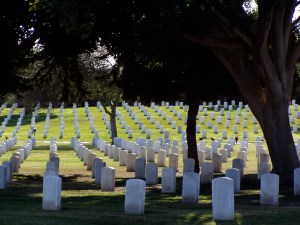
Fort Rosecrans National Cemetery

Good Grief

Lamentations 3: 19-30    John 11:1-20, 30-37

On May 5, 1868 General John A Logan, as the commander-in-chief of a veterans organization issued a proclamation that Decoration Day should be observed nation-wide.(1) Decoration Day is very traditional throughout parts of America. So traditional in fact that we don’t know when or where it started. It seems to have just appeared in multiple communities, perhaps as a corporate response to death. What we do know is that Decoration Day came to be celebrated throughout America around the end of the Civil War. It was a time, historically, during which the gruesomeness and numbers of human deaths not only seemed unparalleled in American history, but devastated communities because the war was so divisive. As General Logan sought to make Decoration Day a national event, May 30th was chosen specifically because it was not the anniversary date of a battle.(2)

Decoration Day has played an important role in American communities. As early as the 1880’s Decoration Day was also called Memorial Day in the South. This name change to Memorial Day in the South may have been a political one to accommodate people who also mourned Confederate soldiers.(3) So Decoration Day became “Memorial Day.” But I feel compelled to point out to you that to this day in the South, Memorial Day, in addition to being a day to honor those who died in the Civil War and World Wars is still held as a day set aside to remember and honor all those loved ones that the community has lost from its corporate life.

Some of you know that my father’s family is in the South. I can tell you that in rural Alabama, Memorial Day—and indeed the remembrance of loved ones who have died—is a bit different from it is here in urban California. Here we have large cemeteries in different regions of the city and often you have to go out of your way to get there. There, cemeteries are scattered everywhere throughout the community, and often they have no walls or fence— just acreage you pass daily on the sides of the roads.

As is common in that rural area, my own father is buried in the churchyard of the church closest to the family land. Many people visit the graves of loved ones daily or weekly. This is part of the Southern culture and expected of those who mourn. But even after mourning, there is a cultural expectation of remembrance.

My step-mother in Alabama makes silk floral arrangements and she will tell you that most of her business is done between April and May each year preparing floral arrangements that will decorate the tombstones of loved ones on the local celebration of Decoration Day and when flags are added to the graves to recognize Memorial Day. And yes, in parts of the South some people plan these arrangements out months in advance. To neglect to decorate the graves of your loved ones this time of year it is a serious cultural taboo akin to forgetting Thanksgiving and Christmas. In some ways all this effort of decoration seems strange. But in some ways, being adopted into my step mother’s culture, it makes sense and seems almost comforting to have a communal event remembering and honoring individual losses and creating public space for the needs of those who grieve.

If this still seems foreign to you, I can liken the rituals of Decoration Day only to the cultural and religious festival of Dia De Los Muertos—Day of the Dead—that we in southern California may witness at the beginning of each November. Indeed, in some lore about origins Decoration Day there is a mention of a woman who wrote that decorating the graves with flowers should be held as a “religious custom of the South.” (4)

Mourning and grieving is not something we often talk about. Because we avoid it, some even say that observation of Memorial Day should be returned to May 30th rather than observed as a three-day weekend that serves more as the opening of summer than the national day of mourning and remembrance it was intended to be. We must admit that with all the commercial sales and BBQ’s and our beautiful beaches mourning and reflection is not something that we really want to do—not with summer coming! Indeed there are many reasons to be distracted from the reality of death.

Our text this morning, however, is one that speaks of the realities of death and is one that clearly shows us a religious custom of grieving. The eleventh chapter of John and its account of mourning leading up to the raising of Lazarus is a text packed with theological implications. There is the question of why Jesus waited two days rather than going to Lazarus immediately and why this seemed so offensive to Mary and Martha. There is the conversation between Jesus and Mary about who and what resurrection is—and its underlying debate about the existence of an afterlife that persists in the Jewish faith. There is the implication that discipleship means following Jesus even when the journey is potentially to one’s own death and then there is the whole issue of Jesus having control over life and death in what comes next in the gospel—the raising of Lazarus, which in the Gospel of John will be the last straw that leads the temple authorities to arrest Jesus.

However, it is the scene of mourning that is of particular interest. Not only are the sisters and family of Lazarus mourning, but community members and friends of the family have also gathered to mourn Lazarus. The Gospel of John is clear that Lazarus and his sisters were friends of Jesus. For Jesus is not sent message that Lazarus, but that he who you love is sick. Jesus is part of the community of friends and family who join in the mourning. It was part of the religious and social customs of the time not only for others to join in the mourning, but for this gathering to continue for a week. Jesus arrives on the fourth day (of mourning). And in one of the most profound moments of the narratives we have of Jesus’s life we are told that “Jesus wept.” (verse 35)

He simply wept for his friend Lazarus. And the grief of Lazarus’s sisters.

Before the gospel account gets on with its important points of drawing parallels between the raising of Lazarus and the resurrection of Christ or illustrating that Jesus has power over death or even suggesting that God is about to do a new thing, never seen by humanity, it proclaims that even the Son of God pauses to mourn and to grieve.

It is a gospel lesson that we may do well to relearn in this twenty-first century. Too often in our fast paced world the once-natural processes of life and death are rushed so production is not slowed and we don’t fall too far behind.

In some cultures it is normal to have an extended period of mourning when a loved one dies. But too often in our American culture, we get three days’ bereavement leave. According to tradition not only would Lazarus’ sisters have a week of mourning after the funeral but another month of lesser mourning and, depending on the relationship one has with the person who died, the period of mourning may last up to a year. To us this period of mourning may seem a luxury, but it may be necessary.

Before the Civil War, death was a common part of life. In the period following the Civil War, when Decoration Days were first established, the numbers of deaths society had to adjust to because of the war was uncommon and so required a new approach to corporate mourning.

As I read around and reflected on the grief in our text this morning, it was interesting to note that while pastoral care, psychology, and even biblical scholars agree that death is a separation of relationship that has to be experienced and in time readjusted to, that all these disciplines also make note of the fact that the sheer number of deaths in the World War I and World War II forever changed how we culturally approach the reality of death by making burials more industrial and less personal. Following the thousands of tragic deaths on 9/11 and the wars that have followed, some (scholars) seem to question how we might cope with all our losses. (5)

How we might ever cope with our grief is a good question. It seems clear that we can’t avoid mourning. It seems clear that a short bereavement will not fill our needs. The Gospel of John shows the human and divine Jesus pausing to mourn. Generations before us have set time aside for us to grieve and remember those who have died. Many religious traditions, including our own Christian seasons of Lent and Good Friday, require periods of mourning. Still, culturally we avoid mourning and deny death.

Lamentations is one of the few books permissible for Jewish mourners to read. It is a book that chronicles the complaints and grief of the people following the destruction of Jerusalem in 587 BCE. Here we find an ancient doxology detailing God’s faithfulness, speaking from a time and place that seemed to its author the end of the world. It’s not just about faith, but there is something more in it. The word “hope” it uses (in verse 21) also means “expectation” indicating that even in the most dire of times we can expect God’s faithfulness. (6) Perhaps this was the source of the expectation Mary and Martha had of Jesus to come to Lazarus. Our modern expectation is not necessarily that God will fix all things to our liking but an expectation that God will come and be there in depth of our despair.

We never know when God may do a new thing. But we know God is present with us in our joy and in our sorrow. There is a wisdom we have been given which we may want to recall this Memorial Day, as we remember our personal losses, and as we mark the death of 1000 American soldiers in Afghanistan.

The wisdom of Ecclesiastes is this:

There is a time for everything…
a time to be born, and a time to die…
a time to weep, and a time to laugh,
a time to mourn, and time to dance…
a time for war, and a time for peace.

—Eccs 3:1, 2a, 4, and 8b

*** Endnotes

  1. “Memorial day” [on-line] at http://en.wikipedia.org/wiki/Memorial_day accessed On May 29, 2010.
  2. ibid.
  3. ibid.
  4. “Confederate Memorial Day” [on-line] available at http://en.wikipedia.org/wiki/Confederate_Memorial_Day accessed May 29, 2011.
  5. Gene Fowler, Caring Through the Funeral: A Pastor’s Guide, (St Louis: Chalice Press, 2004)
  6. The Broadman Bible Commentary. Vol.6. (Nashville:broadman, 1971) 216.

Thoughts on Being Ordained

So I have been ordained for nearly three weeks now. Some have wondered why I haven’t written about this sooner. Well there is the rub. Ordination, while often seen as a destination along the journey to that point, is really just a beginning—the beginning of the work of ministry; the beginning of trying to keep up with God. I was trying to keep up with God before, yes, but truly the last three weeks have been a whirlwind seemingly stuck on fast forward, as it’s going to be a while before things re-approach “normal” speed. God seems to be running a marathon with me as of late! And that’s all okay with me!

God is not only difficult to define or describe, but God is beyond all our definitions and expectations! Just when you think you understand God, God shows God’s self in ways and what you can not understand. God is ineffable. This is part of what I tried to convey in my ordination paper when I termed God a Trickster. I’m so glad Rev. Jerry Lawritson mentioned that in the sermon at my ordination. Ever hear of the yoke of Jeremiah? But, I digress. Or perhaps not.

There are some things about being ordained that I did not expect, and some moments in being ordained that carried great meaning. I’ll speak to the latter. I have to say that one of the unexpected moments of my ordination that continues to carry great meaning was the laying on of hands. I am not going to go into the politics of ordination here, but suffice to say that after all the trials one goes through in “proving” they can meet the requirements of ordination and early ministry, for me—particularly as a disabled woman, reared in poverty, who has been made to feel “less than” most of her life—to hear the congregation say “Yes she is worthy, let us ordain her” and then to see local clergy immediately get up, hover over and encircle me was overwhelming! It was empowering. It was a confirmation that boosted my confidence. And at a certain level it was also a great relief for here I was exactly where I had known for so long I was meant to be AND the community and the clergy acknowledged it! Even if, at the same time, it seemed at some level that it was late in coming, it truly felt meaningful, a moment of awe for me. It was not the confirmation of my call—for what human acts, no matter the ritual history or intent, can confirm the call of God? But it felt as if God was jumping up and down, celebrating because the community “got” the call. It felt like an act of God. And I still feel the awe.

Ordination is worth struggling for. I understand this now in a much more profound way. In churches where women, GLBT, persons with disabilities are not eligible for ordination, ordination is worth struggling for because the call to ministry is not a call of the Church, but a call from and an act of God. For my friends who continue in the ordination process, to friends who have newly received their Masters of Divinity and seek to serve, to the Rev. Elvin Harrison who seeks privilege of call in the UCC tomorrow, to seminarians with disabilities who faithfully struggle to follow their call when the possibility of ordination still seems a hazy dream come to oppress them from a heavenly land let my ordination be an encouragement to you…yes, your ordination is worth struggling for, especially when it seems it might require an act of God! God is with you.

An Easter Treat!

Had to share this for Holy Week!
The Women Preached it First, UCC