Holding Fast to God: Lent 4

There is so much richness in the lectionary for this week that it is hard to know where to start. What strikes me in the texts for the third week is that both Psalm 23 and the story of the Man Born Blind (John 9:1-41) have very little to do with one another and yet in the end they both point us towards holding fast on to God even when that seems irrational and all else is seeming lost. In the depths of these texts I sense that there is a calm center—the welcoming of God, Godself—in the midst of the chaos that surrounds the central character of each text.

I doubt I will ever forget a seminary afternoon I spent in Psalms class taught by Dr. Kristin De Troyer, an amazing scholar and teacher! This particular afternoon we were looking at Psalm 23, and going through it line by line examining the poetic stress and how the word pairs worked to enhance the meaning of the text both in translation and in Hebrew. A text that has almost come to seem cliché jumped out at me. As Professor De Troyer took us through this text it became clear that it was not only not a simple text, but also that it was far from the pastoral text the images depict. This is perhaps one of the most familiar texts in the Western world. “The Lord is my shepherd…” The words themselves are so calming to even think. (Although I must admit that after encountering the Vicar of Dibley series I found myself giggling every time I heard the opening of this Psalm because it had become such a lead into comedy for me. But I digress…) However, as I think back to that day in seminary, in the long warm conference room, I think of how sad it is to me that this text is so misunderstood and so misused. As the professor unpacked the word pairings of the text and went through the images of the text with us in view of its ancient origins, it came alive for me in new ways. Professor De Troyer led us on a discovery that this text is one of flight and seeking refuge. The table which God is said to prepare in this text is not just a meal table, not a welcome table but rather the alter in the tremble where one might seek refuge—the one place that a hunted or chased person may find refuge, for no army and no official could lawfully seize a person who had to the ram’s horn on the altar of God. And not only is the text one of safety for the person in peril, but it is also one of vindication.

I thought on that day, how strange it is to use the text of Psalm 23 as a text for the time nearing death. It seems to me that the context of death is the one in which Psalm 23 is often used. I remember thinking to myself on that day in seminary, that I would uphold the integrity of the poetics of the text and not use it in the context of death because in my class I was learning that really the text is more appropriate to the situation of the immigrant running from immigration officials than it is for the death bed! But such can be the arrogance of pure academic scholarship mixed with inexperience. As a chaplain I quickly learned that despite the meanings unearthed by the poetics of this text, the fact that this text brings meaning and comfort to people in various situations but particularly at time of great illness and approaching/at death cannot be ignored. As a poet, it first pained me to use this text in the context of illness/death. However as chaplain—and even as a poet—there is something more important than intent to tend to. There is always at the heart of all matters the meaning and care for others that must be considered. In my experience as a chaplain I have learned that even people who are not religiously affiliated will ask for Psalm 23 to be read at time of death. It has become easy, both for the scholar and the poet within, to allow my poet self to read Psalm 23 in the context of illness/death. This is true not only because it is caring to read something that has meaning to those who request it at these times, but also it is true because of the death/dying process itself. The death/dying process itself is one of letting go of all we love—be it things, people, places, and how we identify ourselves. In this sense the death/dying process is one of seeking refuge in the only place we have left to turn when all else falls away—God, or our understanding of the sacred. In some small way Psalm 23—which is really more about refuge from the world than death—is in a way one of the perfect and most simple texts to turn to for reassurance, whenever we need it, and often that is the time close to dying.

The paradox of this struck me this week as I taught Sunday School to the four and five year olds—and Psalm 23 was the text for the week. Here Psalm 23 was in no way connected to ideas of death and dying, there was no thought given the notion of fleeing for one’s life or seeking refuge, but rather the image of the shepherd became the focal point for discussions of care, compassion, and God’s love for us. It was a bit odd I admit for the hospice chaplain to be teaching Psalm 23 to a group who, God willing, will long outlive me. But it was also a moment in which I found wholeness. For, as we first learn Psalm 23 (particularly if we know what a sheep is only though books and we have to learn what a shepherd is) we learn that God is present with us at all times and that God cares for us through others who feed and tend to us when we are sick. There is omnipresence, we are never alone. God holds fast to us so we may hold fast to God.

By now you may be thinking that at the outset I mentioned this was also the case in the gospel for this week, in the story of the man born blind. Well it is. This is one of the “healing stories” in the gospel, and generally I find these complicated and problematic. This story from the ninth chapter of the Gospel of John, however, is one that important and liberating to a point. It is in this text that Jesus clarifies for all those around that sin is not the cause of disability for Jesus says “Neither this man nor his parents sinned, he was born blind so that God’s works might be revealed through him” (John 9:3). This is very liberating to people with disabilities because it separates sin from disability, in the words of Jesus, and long before science would show this to be true. Rev. Dr. Kathy Black points out that this healing story is different than others found in the gospels because whereas other healing stories end with the person with disabilities being integrated back in the community, in the case of the man born blind Jesus’ healing of the man results in his being expelled from the community. (A Healing Homiletic: Preaching and Disability, Abington: Nashville, 1996, 72-73.) The blind man’s encounter with Jesus and his healing lead to controversy within his faith community. The man not only proclaims the work of Jesus to his community but he also calls Jesus a prophet! Like a good shepherd, Jesus seeks out the man when the community expels him and then the newly-sighted man accepts Jesus as the Son of Man. The healed man held fast to his experience of God, even when he faced losing his community because of it, and Jesus came to him there.

Whether we struggle with fault/blame, change, leaving, or how to approach the other this Lenten season let us hold fast to God with the hope that God holds fast to us as well.
Others: Lent 3

The Lectionary reading for the third week of Lent is John 4:4-42. It is the text about the Samaritan Woman at the well and her conversation with Jesus.

I want to start by thanking my former seminary classmate, the Rev. Alison Rainey English, for posting this video on Facebook. I thought this was a breathtaking retelling of the text, so take a minute and watch it:

This video reminds me that the art of biblical story telling is one that I have much respect for. It is an art that seeks to tell a story in a new way, to reach out and shake the audience into new awareness of what is being said, much like poetry does. Perhaps this is why this particular video strikes me. (There are other similar portrayals of this text.) It makes me take notice of the woman at the well and her story that became so much of the encounter with Jesus.

I have been pondering this text in part becuase it may be used in a worship service that I am helping to plan for a conference this summer. It is indeed a rich text, perhaps one that begs for the liturgical arts be present as witnesses to it. But this text is also one that comes up time and again when we talk about crossing social boundaries to invite others to our faith and to include them in worship. Here is a woman possibly outcast in her own society, certainly a woman who has seen her share of trouble, who is also a member of outcast group talking with Jesus. Jesus who does not shy away from her but engages in dialogue with her. Gail R. O’Day makes an interesting point by naming that while this woman is often seen in some immoral light because she has had five husbands Jesus does not condemn her for this but rather allows her to become an apostle by telling her people about him (Gail R O’Day, “John” in The Women’s Bible Commentary, Westminster: Louisville, 1992, 296). The truth is we don’t know much about the history of this woman before she meets Jesus. She may have been repeatedly widowed or part of a non-Jewish marriage that was based simply on a contract that could be exited at will–but we know what she does when she meets Jesus, that she unlike many in the gospels recognize Jesus as the Messiah, and we know she acts as an apostle after meeting Jesus.

It is precisely the actions of this woman in contrast to those of the disciples that strike me as a Lenten nugget in this text. This woman is outcast as a woman, outcast as a Samaritan, outcast by having a personal history; this woman is not only welcomed by Jesus but takes it upon herself to become an apostle. This Lenten season we have thought about fault and sin, about leaving and change, and now we are faced with a text that appears to lift up a person who would not be lifted up as a religious example as one who sees and seeks the truth. The woman at the well is the other who only seeks truth and love while being denied both by society. But all that changes when she meets Jesus. For Jesus reveals the truth to her, a truth that sends her back into her community, where she might to be listened to.

Could it be that the Lenten journey is one that not only calls us to examine our own actions but to also examine our social expectations to consider who we may be missing, and the truth they have to share, when we decide who is in and who is out according to our traditions? Jesus did not exclude persons; he always found a way to bring the other in. Perhaps this third week of Lent we are called to meditate on that part of the journey. The stories we could tell, and we still have so far to go!

Fault: Lent 1

Lent has taken many forms over the years. In the early Christian Church Lent was time of preparation for baptism. Lent has also traditionally been a time of penitence. To this day many Christian communities view Lent as a season of personal reflection on how to live up to Christian ideals. There seems to be a current shift in the observances of Lent with many Christians now using this time to intentionally take up spiritual practices and draw closer to God. Whether drawing closer to God, engaging in personal reflections, observing the practice of penitence, or preparing for new life, the scriptures in the Bible seem to be one of the foundations to which we, as Christians, turn during this season. For this reason, I will be attempting through out this Lenten season to offer some scriptural reflections on this blog and these reflections will be based on the Revised Common Lectionary (RCL) or feminist lectionary Women’s Stories from Scripture for Sundays and Festivals: Remembering the Women by J. Frank Henderson, which also follows the RCL while offering passages reflecting the lives of biblical women to be used when the RCL does not.

Perhaps I should not be surprised that the scripture for the first week of Lent, the season of repentance and reflecting on sins, is Genesis 2:15-17; 3:1-7 about Eve and Adam eating of the Tree of Knowledge in the Garden of Eden. It is a text often pointed to as proof of “Original Sin,” the “untrustworthy” or “evil” nature of women. If you are unfamiliar with this passage or would like to refresh your reading of the text you may do so here. It is a text that has long affected the relationships of men and women, particularly in the realm of religious understanding and authority. But what does it say to us in Lent, about penitence, about drawing closer to God, about living the Christian life today?

I recently had occasion to re watch an episode of Bill Moyer’s wonderful PBS series Genesis in which Moyers, himself a pastor, gathers a variety of thinkers, artisans, scholars, and theologians to reflect on the major stories in the Book of Genesis. One of the Genesis episodes named “Temptation” addresses the Genesis passage about Adam, Eve, and the Tree of Knowledge. (And yes I must admit spending an hour listening to scholars discuss this was heavenly.) I mention this episode because in rewatching it I was particularly struck by two issues in the Adam and Eve text that I don’t think we often talk critically about: fault and relationship.

So often we approach this text with our tendency to idealize and analyze, and I wonder if in doing so we miss something important. We often imagine Adam and Eve in the garden with all their needs meet and without much worry. Perhaps it was ideal, certainly having all my needs met so I can simply be sounds ideal. But Adam and Eve were human. I have not lived as long as some people have but it does seem to me that one of the traits of our humanity is that if things get too easy we become bored; when we have too few challenges we wonder about new things, we strive to do something new, something to change the status quo although we always hope it will change for the better. It seems that some of that is a foot in this text from Genesis. Eve acts. If we ponder that without judgment for just a minute (go on, I dare you!) we see something different emerging from this. Steven Mitchell, in the Genesis episode comments that Eve is “the one who makes everything happen, who acts out of love for God, if God is wisdom.” (Genesis: a Living Conversation, New York: Doubleday 1996, 47.) In the text the serpent tells Eve “your eyes will be opened, and you will be like God knowing good and evil.” It is in some ways Eve’s eating of the fruit was a very Lenten act for it was an act to become closer to God, to “be like God”.

Yet, seeking to be closer to God can often change things in unforeseen ways. In the Genesis story, Eve took a human risk to do something different in order to become closer to God. But things did not work out the way Eve expected. There is in the text evidence that God told Adam not to eat of the Tree of Knowledge before Eve was a part of the story, Eve may not have had this command directed at her. Nevertheless, whether Eve defied God, as is often said of this text, or whether Eve was acting out of innocence (which seems a closer reading of the text) Eve’s eating of the fruit changes the relationships in the Garden. In Genesis, prior to this episode God is portrayed as walking in the Garden with Adam and Eve. Yet that changes after the eating of the fruit. In the Genesis episode Marianne Meye Thompson makes the point that after the fruit is eaten “they clothe themselves, as if to hide from each other. And they also hide from God.” (Genesis, 52). The text then is about human changes. Changes in human ingenuity, changes in human spirituality, changes in relationships between man and woman as well as between humans and God.

Our text seems to indicate that changes in ourselves also lead to changes in our relationships with others. One of the other things I have noticed about humans is that we don’t like change. Adam very much portrays that aspect of human nature in this story. For when God asks why they are hiding, why they know they are naked, Adam explains that Eve gave him the fruit to eat. God does not fall for it. God does not tell the pair that everything is going to be okay. Rather, God acknowledges the change in all their relationships that will take place, perhaps because of their acts, but also because of the change that has taken place in the man and woman themselves. Not only is change never easy, but in this case the change also brings about suffering. In the Genesis episode Elaine Pagles says of this text that “it insists that suffering has to be somebody’s fault.” (Genesis, 50.) As Christians we live with a tradition that (perhaps not originally) for many centuries has taught that this is a text that tells of how a woman brought sin into the world and how man was given power over her. Sin is a form of suffering. And yes this is a text that speaks to how suffering came about in the world. But woman did not bring suffering into the world. The wisdom of acknowledging suffering existed in the Garden, locked in the Tree of Knowledge, before Eve was ever there. Once that knowledge of suffering, once innocence, came out it could not be put back. There was change; change that required Adam and Eve change their relationships to one another. Once change is proclaimed, it is not always a pronouncement about the way things will be forever. We know this. As Christians, it becomes part of our being. For our teacher Jesus was always challenging the ways people related to one another, turning relationships upside down, inviting the outcasts—even the outcasts from the Garden—back in. Change is part of the Good News!

So, welcome to Lent. Whatever you seek to do this season whether penitence for sins or drawing closer to God through spiritual practices, be aware that such changes can have profound effects on all your relationships. And may God be with you on the journey.

Hair!

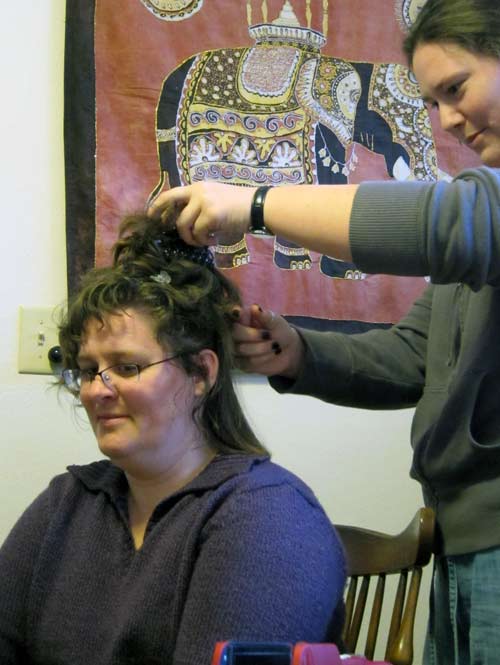
kelli getting her hair straightened for the first time by amandaI am going to call it my “Vicar Do”! That is right, I am writing about ministry and hair style. I did not intend my new do to be an homage to the Vicar of Dibley, and I don’t think it is per se, but now that my hair is cut it does make me think of the Vicar in that hilarious series.

When you think of all that goes into ministry, it seems ridiculous that something like hair style should matter. Yet, for women clergy it does! Let’s not be fooled. How a woman wears her hair has always been an issue in some churches for even the Apostle Paul comments on what women, in the Corinthian church, ought to do with their hair (1 Corinthians 11: 5-6). True, it matters for men as well. But lets face it men’s hair styles are limited to how short one wants it –even if, and I know some male clergy do, the guys want to style and poof the hair it a bit or polish the bald head. No matter how wrong it seems when dealing with issues of justice and spirituality, I have learned the hard way, how one looks effects how one is perceived by those you serve. And often those you serve look at all parts of your life, and yes, there is judgment in that. A negative perception can be disastrous for the unfolding of one’s ministry. That alone makes one’s image an issue of professional development and discernment. BLAH~ it goes against every grain of my being but there it is.

So yes, I got a new hair style today. Personally it was time for a change. Then the hard part started–choosing the new style. How is it the next hair style going to look in the pulpit? Immediately, I heard my preaching professor from seminary critiquing every one of my sermons saying “get the hair out of your eyes!” Certainly something to consider in selecting a new style. But then there is the issue of femininity. Should my hair be longer or shorter, and what do both of those options portray to potential congregations? Will short hair be as big an obstacle as boobs are to being a chaplain to people with different ideas or expectations regarding the role of women? I think women have much to consider when choosing a hair style. At least I do. Will it make me look like someone I am not? Am I willing to risk portraying that to the world? What am I portraying, and is it what I mean? BLAH, again~with the full realization that if I don’t ask someone else will. It’s too reminiscent of when I interviewed for CPE only to be told they would accept me but the committee thought I should “invest in some new clothes and a haircut” before starting the residency. Were they KIDDING me?!? Unfortunately, I am not the only woman clergy person I know to have been told something like this.

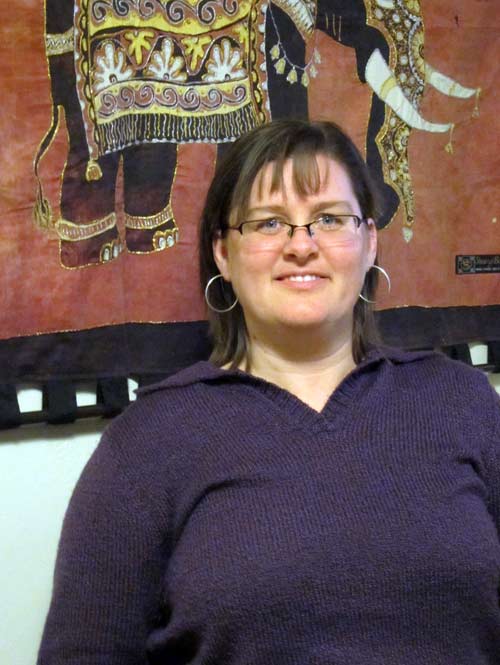
kelli looking all sharp and professional with shorter and straight hair. a first for her.Of course, I consulted a friend with far more fashion sense than myself. (Fashion clearly was not one the gifts Spirit gave me, but I have so many others that I don’t care. It takes all of us, so as I understand it I can safely rely on others for help~see 1 Corinthians 12.) This fashion friend well understands my professional role, because she shares it. Of course I trust my hair stylist, too, who knows my vocation and profession. Her name is Bernice, the same name that the Acts of Pilate gives to the hemorrhaging woman in the Gospel of Luke. So I like to think of my hair stylist as a biblical woman when she is working on my hair. It helps me~have I mentioned that not only do I lack the fashion gene but that I just don’t care about things like ‘doing my hair’? BLAH~ but here it is a new hair style, which I think I like. And, yet, as I sit here no one I know has seen the new doo. And as all those question about how it works and the perceptions it gives off are swirling in my mind, unanswered. It strikes me that a life of faith is peppered with moments like this. When we hope for the best, even when we have no idea what may come~let alone how people will react. Perhaps I must just have faith that all shall be well. And if not I guess, in this case, it will grow out.

UCC “Widening the Welcome” —Again…More ‘Firsts’

The UCC has a history of being a denomination of firsts! Thus, I lift up to you some new firsts that have occurred within the UCC. At the end of September approximately 300 people, from Maine to Hawaii, gathered in St Louis, Missouri for the “Widening the Welcome” Conference. It was the first UCC Disability Ministry Conference! It may have been the first disability ministry conference, ever. As I talked with other people in attendance it became apparent that this was also the first conference (religious, academic, or professional) that attendees could remember that brought the issues of mental illness/brain disorders and disability together for reflection, communion, and dialogue about the future of ministry and inclusion. In the disability and mental illness communities this gathering was rather a big deal!

Beside the breath-taking St Louis Arch that symbolizes what was once the gateway to new frontiers, UCC members, clergy, people living with and without disability and/or mental illness came together to reflect on the ministries of inclusion they were already involved with and to learn from one another how the local church might be more inclusive of people with disabilities or mental illness and their families. Keynote speakers included Dr. Sister Nancy Kehoe, a Clinical Instructor in Psychology who spoke about her experience integrating spirituality in the realm of mental health services and offered workshops on how this can be a practical and supportive ministry in local settings, and Dr. Debbie Cramer Assistant Professor at Iliff School of Theology spoke about disability theology. Rev. Dr. Jane Fisler Hoffman preached the importance of including persons, including clergy, with mental illness in our faith communities. Rev. Bob Molsberry challenged us to consider who the “guest” is and who the “host” might really be when we encounter people with disabilities in our churches. Rev. Peter Bauer was also a force at the conference reminding us that both traumatic brain injuries and post traumatic stress disorder are huge issues for soldiers returning from war and that this presents a challenge to clergy who “4 times out of 10” are the first professionals who people with PTSD may seek help from, as well as being a challenge for congregations that have members returning from war or congregations that are engaged in ministry to military families and personnel. There were many more wonderful discussions and speakers at the conference–this is only a sampling.

The Widening the Welcome (WtW) conference was important in content and more about that can be found at the conference’s website (below), but it was also important in fellowship. For the first time people involved in doing disability ministry, those involved with the academic writing of disability theology, persons with disabilities who had been included in the church, those with disabilities or family with disabilities who sought deeper inclusion in the church, clergy with disabilities, seminarians with disabilities, and their allies were all gathered in one place. It was a time to reflect on where the UCC really was thirty-three years after passing its first Synod resolution about including people with disabilities and where we have still to grow as local churches and as a denomination into our 2005 Synod resolution urging us to be churches “Accessible 2 All”. In fact, bearing witness to this gathering, our UCC General Conference Minister, Rev. Geoffery Black addressed the conference, saying that the Disability Ministry and Mental Illness Network of the UCC “are a movement within the movement of the UCC”. True to that statement, a small group of attendees met, post-conference, to plan what the UCC Disabilities Ministries and UCC Mental Illness Network will bring to the 2011 Synod and to start planning the next “Widening the Welcome” Conference for September 2011.

The ‘movement with’ the UCC to “widen the welcome”, again, has begun. Stay alert for information about the Widening the Welcome 2 Conference planned for September 2011. And, if you are wishing now that you had had the opportunity to tap into the vast resources the first conference provided then I offer you the following ideas:

  • The keynote addresses and individual workshops at WtW were recorded for distribution and are available on DVD; for more information on how to obtain these resources go to the Widening the Welcome conference website at: http://www.moredomainsforless.com/wideningthewelcome/index.htm.
  • Connect with the UCC Disabilities Ministries or the UCC Mental Illness Network, both have websites with lots of information; and Widening the Welcome has a Facebook presence you may join.
  • Get involved in disability ministry! The UCCDM resource ‘Anybody, Everybody, Christ’s Body’ is a wonderful resource for people who want to learn more or lead a congregational study on including people with disabilities, and you can download it for FREE!

Finally, if this is an interest to you, reach out! I would love to connect and work with people/congregations who are interested in disability ministry. Above all the UCC Disabilities Ministry conference highlighted that as a communion of local churches we are resources for one another in learning to continue to bring all persons on the margins not only into our doors but also into full participation with the gospel, our congregations, and our many ministries.

A Feminist Eschatology

The following article was prepared for a seminary class in 2007.

Eschatology is the study of human thoughts concerning what is “last”; translated from the Greek, eschatology means study of the last (1). The question this raises for me is: the last what? Theologically speaking, eschatology is commonly thought to refer to culmination of history or the end of time. In Christianity, eschatology is often associated with the coming of God’s Kingdom on Earth as it is in Heaven, and the return of Christ. For religions that place emphasis on the historical patterns of time, such as the Abrahamic religions, eschatology can serve as a “hope [that] locates the ultimate achievement of the ideal in a final era of human history” (2). Ultimately, eschatology leads us to reflect upon what it is that we consider to be ideal, and perhaps essential to the human experience in relation to both the world in which we reside, and the divinity in which we live and have our being. The exploration I will seek to engage in this brief essay is how some feminist theologians approach this notion of eschatology. What are the last things that feminist theologians hope for? What, ultimately, do feminist theologies hope for?

Traditionally, eschatology has brought to mind the Battle of Armageddon, and the notion of some who are cosmically crowned by a heavenly king, while others are sentenced to eternal torture. These images themselves smack of patriarchy with all its war, hierarchy, and threats to non-conformers. Feminist theologians, starting from the ground of their own experience and carrying with them a commitment to non-hierarchical structures, have tended to view eschatology in a different light, and use a different vocabulary in reference to it. Justice is one word that seems common in feminist discussions and visions of the eschaton.

Building on a tradition that emphasizes history in its concept of world completion, Rosemary Radford Ruether draws an eschatological vision based on the jubilee notion found in the Jewish and Christian scriptures. She writes that “[i]n the Jubilee tradition this is thought of not as one ‘great cycle’ defining history from a beginning to an end but as a series of revolutionary transformations that continually return to certain starting points” (3). The idea of jubilee is that each family has possession of the land they need to provide for their means, and that individuals are free to benefit from the land. It is an idea that all have what they need to survive; this is the starting point to which justice returns in the world. An eschatological vision based on this would have to assume an ongoing process of justice in which injustices are righted and the necessary means of life restored to all persons on a regular basis. Ruether sees this “concept of social change as a conversion to the center, conversion to the earth and each other, rather than flight into an unrealizable future.” (4). It is ultimately justice among persons in community, and all the responsibility that entails, that Ruether advocates as an eschatological hope. It is a hope in which the ultimate meaning of humanity comes in the form of personal responsibility and a communal justice that encompasses all the earth. This is justice.

Justice—and the struggle for it—is also a primary (if not ultimate) goal for other feminist theologians. Judith Plaskow, as a Jewish feminist theologian, is even bolder in this pursuit writing of “the relationship between spirituality and politics as a theological issue” (5). The politics of which Plaskow speaks is social justice. The connection of politics and spirituality is paramount to Plaskow because drawing upon her Jewish tradition she reminds us “the prophets affirm that the forms of worship are meaningless in the absence of social justice” (6). Thus the Jewish tradition, and the Christian tradition that stands upon it, demands the not just the uplifting of but the reality of social justice as a prerequisite for worship. It is only through social justice that humanity can reach toward “new understandings of divinity” (7). Eschatology for Plaskow seems to be a reaching out for and bringing in those persons society marginalizes and considers to be “last.” This requires a political understanding and interaction with the world, because, “[w]hen spirituality is understood from a feminist perspective—not in otherworld terms, but as the fullness of our relationships with ourselves, others and God—it can not possibly be detached from the conditions of our existence.” (8).

Experience as the basis for the formation of theological and spiritual reflection is at the heart of Ada Maria Isasi-Diaz’s Mujerista Theology. Isasi-Diaz’s eschatology is one in which, like Plaskow’s, there is an expectation that the establishment of justice will also bring with it the establishment of the kin-dom (sic). She writes that “[t]he main obstacle to the unfolding of the kin-dom is the alienation from each other experienced by all in and through the oppressive societal categories and structures that cause and sustain oppression.” (9). Thus, the kin-dom exists when oppression is banished and liberation established. The eschatology here is, again, a function of human interactions. As a Latina, Iassi-Diaz not only writes her theology from a feminist perspective, but also from a perspective that seeks liberation, culturally from within and racially from without. In this effort to organize for the liberation of the poor, of women, and of Latinas/os, Isasi-Diaz’s theology puts emphasis on the practical steps of how to build a community that will bring about the kin-dom. Such practicality is based on her emphasis that change will only begin when the oppressed achieve “conscientization” (10) of their situation and the oppressors are able to find their way to being in dialogical solidarity (11) and mutuality in which the oppressors come to understand the oppressed (12). From the perspective of Isasi-Diaz’s theology, it is justice between the people, with power and those without, that becomes the determining factor of when the ultimate hopes of humanity are achieved . Yet, this justice is “ever changing” based on the lived realities of people’s real experiences (13).

There are many ways in which eschatology has been and can be viewed. Often when we look to eschatology there seems to be little agreement about what the last things or times are. However, when we look at the question of what eschatology is from the feminist perspective there seems to be agreement, even across interfaith lines. Feminist theologies seem to agree that the eschaton, the ultimate hope for humanity, will be found only in the seeking and establishing of justice (Plaskow and Isasi-Diaz), or in the establishment of new ways of living in which seeks right relationships and justice among all inhabitants of the earth, human or not (Ruether). In terms of feminist theology, the eschaton is the realization of justice for and inclusion of those persons, and beings, whom are thought of last in the traditional hierarchies of power and control. There is also the implicit expectation of feminist theologians that this feminist eschatology includes roles and respect for women in the ecclesiastical / religious power structures.

***Endnotes

  1. Wikipedia contributors, “Eschatology,” Wikipedia, The Free Encyclopedia, http://en.wikipedia.org/w/index.php?title=Eschatology&oldid=175010037 (accessed December 4, 2007).
  2. Rosemary Radford Ruether, Sexism and God-Talk: Toward a Feminist Theology, (Boston: Beacon Press, 1993), 243.
  3. Ibid, 254.
  4. Ibid, 255-256.
  5. Judith Plaskow, Standing Again at Sinai: Judaism from a Feminist Perspective, (San Francsico: HarperSanFrancisco, 1990), 212.
  6. Ibid, 214.
  7. Ibid, 238.
  8. Ibid, 213.
  9. Ada Maria Isasi-Diaz, Mujerista Theology, (New York: Orbis, 1996) 90.
  10. Ibid, 94.
  11. Ibid, 97.
  12. Ibid, 89.
  13. Ibid, 116

Bibliography

  • Isasi-Diaz, Ada Maria. Mujerista Theology. New York: Orbis, 1996.
  • Plaskow, Judith. Standing Again at Sinai: Judaism from a Feminist Perspective. San Francisco: HarperSanFrancisco, 1990.
  • Ruether, Rosemary Radford. Sexism and God-Talk: Toward a Feminist Theology. Boston: Beacon Press, 1993.
  • Wikipedia contributors, “Eschatology,” Wikipedia, The Free Encyclopedia, [on-line] available from http://en.wikipedia.org/w/index.php?title=Eschatology&oldid=175010037, accessed December 4, 2007.

Must Read Article

Came across a very good article on Sojourners today. The Sojourner’s article is entitled “Mary and Martha: Women in Ministry in the 21st Century” and was written by Theresa Cho. I am sharing the link to the article so you can read it

Mary and Martha: Women in Ministry in the 21st Century by Theresa Cho

I thought Cho raised many important points about being women clergy in these days. So, let’s talk about it…here is your assignment respond to Cho’s article and let us post it here On Women who Speak in Church!

Vicar of Dibley

To kick off our new site, we watched The Vicar of Dibley. Amanda had never seen it. Was a hoot.

Welcome!

For God is not a God of confusion but of peace. As in all the churches of the saints, let the women keep silent. For it is not permitted for them to speak, but to be in subjection, just as the law says. But if they wish to learn anything, let them ask their own husbands at home. For it is shameful for women to speak in church.

—1 Corinthians 14:33-35

It isn’t accidental this site has the name it has. Sooner or later, women who speak in church (in particular) have to contend with the infamous few lines in Corinthians that seem to give people with smaller hearts and minds all they need to make a roadblock to the lives we feel called to.

This is about women in professional ministry. It isn’t about your grandma’s Church Women’s Auxiliary group. That is SO last century.

So here we are, filled with the spirit and in joyful defiance. Women Who Speak In Church. Welcome!