Presence and Praying for Peace

Two nights ago I attended a candlelight vigil, I had received a text message about it earlier in the day and knew only that a man had been beaten. The text cam from my husband who had heard about this through his volunteer/community ties. From the context of the message I received I suspected hate of some form had to with the beating. I did not have much to go on, but I was moved enough to go to the vigil, and to wear my vestments, although no one had asked me to.

When I arrived at the vigil it was a small gathering and this surprised me, but not for long. I soon found the “organizer” of the event and spoke with him. It turns out that the man who had been beaten, Jason, had been living in a local canyon and someone had beaten him in the head with a rock. No words were said at the vigil no statements made or prayers pronounced. Rather people stood around and talked quietly with others that they knew as they held candles, while Jason fought for his life in the hospital. Many the people gathered knew Jason, some were from the local GLBT community. It was simply a gathering of solidarity.

Shortly after I arrived I was approached by a man in a collar. Turns out this man who spoke with me was a gay Independent American Catholic priest who had left the Roman Catholic Church disheartened by what appeared to be the Catholic Church’s refusal or inability to protect victims of the sexual abuse scandal. The priest reported to me that he was there because he knew Jason; the priest explained that he had met Jason while teaching in the local community. Both the priest and I were there simply to show our solidarity with the victim of this senseless crime and his chosen family, as Jason lay in a hospital bed, reportedly, with a very poor prognosis. We were there to provide presence to those who had gathered; all those who had gathered had gathered to be present.

Later in the evening a group of people came out of the hospital and physically leaned on some of those who had gathered for the vigil. They were Jason’s chosen family. One of the women in this group spoke with me and thanked me for being there. I did not do anything, but I was there. It was a reminder for me of how powerful our simple presence can be for others in time of crises.

So what about the vestments? I thought about this, particularly as the media came in and took pictures of the gathering. It may seem presumptuous, and perhaps it could be seen as such. At moments I felt a bit odd standing there, holding a candle in my clergy robe. But it was not presumptuous. It was not presumptuous because in many ways this event was the parable of the good Samaritan made real in the contemporary context. Here was a man and his extended community in crises and of course it was the role of the clergy to stop and bear witness to the pain of the other in crises. I was not there to fix anything I could not do that. But I could bear witness.

That is not the only reason I was there, though. We live in a society of great violence and marginalization of the poor, the GLBT community, the disability community, those who live with mental illness, those who struggle with addiction or propensity toward violence, and anyone else who steps beyond our norms. The truth is I do not know if Jason belonged to any of these categories expect being poor–he was living in the canyon. I do know, however, that we can not continue to accept senseless and extreme violence toward others within our community and continue to consider our society civilized, period. So I wore my vestments to show that God is with all who suffer, and that the marginalized are noticed by the communities who seek to bring God into the world. I wore my vestments, and I was there silently witnessing the suffering senseless violence perpetrates on its victims and on the community around the victims of violence. I did not offer to pray and I was not asked to pray; Jason’s family told the reporter who covered the “story” they were praying for his recovery. It was a gathering of presence and silent prayer. My prayer was one of peace not only for Jason, but for the community immediately around him, and our larger community that has become so fractured that such violence can occur without community uproar but rather be noted on the evening news before we all tuck into bed for a brief night’s sleep. God help us all.
A photo of  Jason, a homeless man who was beaten in the head with a rock, a candlelight vigil held in his honor.

Kelli to Teach Workshop on A2A at Annual Gathering!

Just want to let you all know that I will be teaching a workshop entitled “Widening our Welcome: Becoming Accessible to All (A2A)” at the Annual gathering of the Southern California Nevada Conference of the UCC on Friday June 3, 2011.

The workshop description is as follows: This workshop will explore the UCC’s historical commitment to including persons with disabilities. An explanation the 2005 General Synod resolution calling upon the UCC to become “Accessible to All” (A2A) and how congregations can work towards becoming A2A, as well as specific tools/skills to enhance how we welcome people with disabilities and their families will be provided. Please come learn and discuss how and why accessibility effects how we present our churches to others on Sunday mornings and throughout the week.

If time allows we may discuss what the UCC Disabilities Ministries (UCCDM) and UCC Mental Illness Network (MIN) are teaming up to do to further the discussion of accessibility and mission of inclusion within the UCC. Come learn about what our General Minister Geoffrey Black calls “a movement within the movement of the UCC.”

Details on this event can be found here. If you can not make this event but are interested in the content, please contact me. This workshop can be taken elsewhere for presentation.

Thoughts on Being Ordained

So I have been ordained for nearly three weeks now. Some have wondered why I haven’t written about this sooner. Well there is the rub. Ordination, while often seen as a destination along the journey to that point, is really just a beginning—the beginning of the work of ministry; the beginning of trying to keep up with God. I was trying to keep up with God before, yes, but truly the last three weeks have been a whirlwind seemingly stuck on fast forward, as it’s going to be a while before things re-approach “normal” speed. God seems to be running a marathon with me as of late! And that’s all okay with me!

God is not only difficult to define or describe, but God is beyond all our definitions and expectations! Just when you think you understand God, God shows God’s self in ways and what you can not understand. God is ineffable. This is part of what I tried to convey in my ordination paper when I termed God a Trickster. I’m so glad Rev. Jerry Lawritson mentioned that in the sermon at my ordination. Ever hear of the yoke of Jeremiah? But, I digress. Or perhaps not.

There are some things about being ordained that I did not expect, and some moments in being ordained that carried great meaning. I’ll speak to the latter. I have to say that one of the unexpected moments of my ordination that continues to carry great meaning was the laying on of hands. I am not going to go into the politics of ordination here, but suffice to say that after all the trials one goes through in “proving” they can meet the requirements of ordination and early ministry, for me—particularly as a disabled woman, reared in poverty, who has been made to feel “less than” most of her life—to hear the congregation say “Yes she is worthy, let us ordain her” and then to see local clergy immediately get up, hover over and encircle me was overwhelming! It was empowering. It was a confirmation that boosted my confidence. And at a certain level it was also a great relief for here I was exactly where I had known for so long I was meant to be AND the community and the clergy acknowledged it! Even if, at the same time, it seemed at some level that it was late in coming, it truly felt meaningful, a moment of awe for me. It was not the confirmation of my call—for what human acts, no matter the ritual history or intent, can confirm the call of God? But it felt as if God was jumping up and down, celebrating because the community “got” the call. It felt like an act of God. And I still feel the awe.

Ordination is worth struggling for. I understand this now in a much more profound way. In churches where women, GLBT, persons with disabilities are not eligible for ordination, ordination is worth struggling for because the call to ministry is not a call of the Church, but a call from and an act of God. For my friends who continue in the ordination process, to friends who have newly received their Masters of Divinity and seek to serve, to the Rev. Elvin Harrison who seeks privilege of call in the UCC tomorrow, to seminarians with disabilities who faithfully struggle to follow their call when the possibility of ordination still seems a hazy dream come to oppress them from a heavenly land let my ordination be an encouragement to you…yes, your ordination is worth struggling for, especially when it seems it might require an act of God! God is with you.

Ordination!

You can call her “Rev.” now.

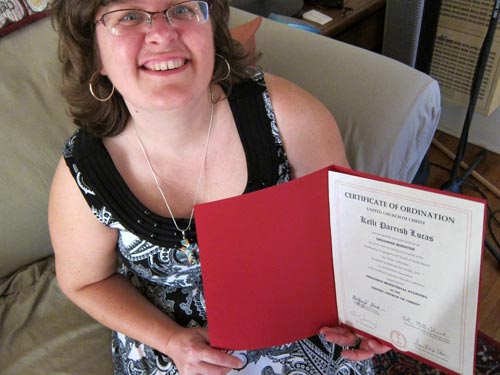
Kelli beaming with ordination certificate finally in hand.

One relieved girl!

We just got back from the festivities following Kelli’s ordination today—long awaited, and taking just a bit over six years since she was accepted to seminary in April 2005. You can imagine this is a huge victory to claim. After our dinner, she was wiped out, so here I am, ever the journalist for the family…

Held at the church where we both were born into and where we have been baptized and married in, this is a particularly notable day in the history of CCCPB, as Kelli is the only of that congregation to have started so young and followed the long and winding path of faith and formation, all the way to this point.

In attendance were members of CCCPB, Mission Hills UCC (where she interned), other churches in the local UCC Association, friends from United Methodist, Disciples of Christ, Unitarian Universalist, and Presbyterian worlds. Friends from the world of chaplaincy, poetry, and plain ol’ good friends were there to support her too. (A few of the ladies might not know it but they might be contributors to this very site, once the dust settles here!)

For the week, Kelli’s mom Kay Taylor was in town, and brought her autoharp with her. She sang a heart melting rendition of God’s Eye is on the Sparrow for the offertory in the ordination service. We just happened to have a mic on her too!

Over 100 images from the day are now on my Facebook page, and concurrent with all this, we are starting the WomenWhoSpeakInChurch page on Facebook too.

To save you a trip to YouTube, check these out:

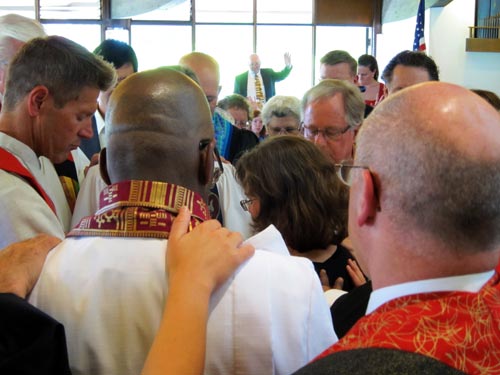
Kelli in the midst of the clergy laying hands.

Laying on of hands, clergy and lay folks

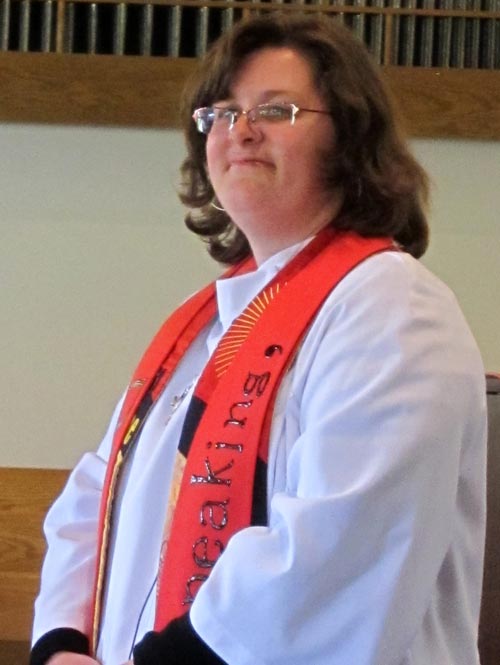
Kelli looking sharp with robe and stole.

Kelli after being robed, and having just distributed the bread in her first communion

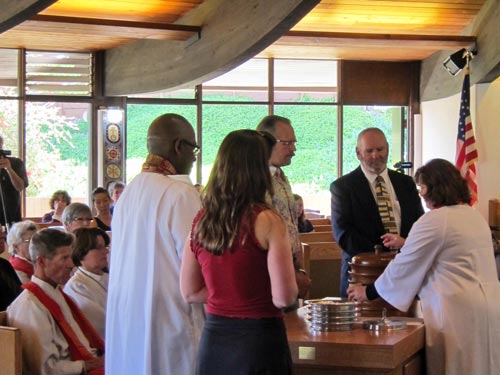
Kelli serving communion for the first time.

Kelli serving the wine at her first communion as "the Rev."

Off to dinner with MHUCC friends and mama Kay.

Kelli and a number of us from Mission Hills Young Adults, out to dinner to celebrate

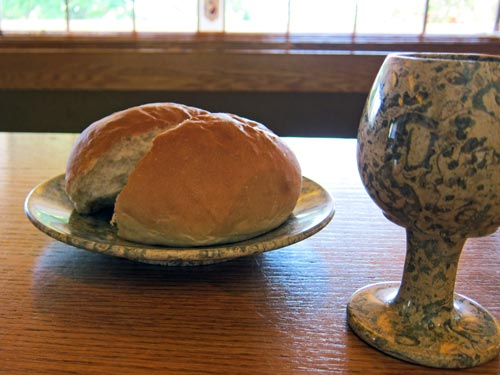
Kelli's new chalice and plate for communion

Kelli's new chalice and plate for communion, made from solid stone from Pakistan

Thanks to Phil, Tara, Margie, and Amanda for heroic help.

Ordination

WOOOOHOOOOO! Kelli just got her ordination date: May 1, 2011! Long time in coming! Bravo, Kelli!

UCC “Widening the Welcome” —Again…More ‘Firsts’

The UCC has a history of being a denomination of firsts! Thus, I lift up to you some new firsts that have occurred within the UCC. At the end of September approximately 300 people, from Maine to Hawaii, gathered in St Louis, Missouri for the “Widening the Welcome” Conference. It was the first UCC Disability Ministry Conference! It may have been the first disability ministry conference, ever. As I talked with other people in attendance it became apparent that this was also the first conference (religious, academic, or professional) that attendees could remember that brought the issues of mental illness/brain disorders and disability together for reflection, communion, and dialogue about the future of ministry and inclusion. In the disability and mental illness communities this gathering was rather a big deal!

Beside the breath-taking St Louis Arch that symbolizes what was once the gateway to new frontiers, UCC members, clergy, people living with and without disability and/or mental illness came together to reflect on the ministries of inclusion they were already involved with and to learn from one another how the local church might be more inclusive of people with disabilities or mental illness and their families. Keynote speakers included Dr. Sister Nancy Kehoe, a Clinical Instructor in Psychology who spoke about her experience integrating spirituality in the realm of mental health services and offered workshops on how this can be a practical and supportive ministry in local settings, and Dr. Debbie Cramer Assistant Professor at Iliff School of Theology spoke about disability theology. Rev. Dr. Jane Fisler Hoffman preached the importance of including persons, including clergy, with mental illness in our faith communities. Rev. Bob Molsberry challenged us to consider who the “guest” is and who the “host” might really be when we encounter people with disabilities in our churches. Rev. Peter Bauer was also a force at the conference reminding us that both traumatic brain injuries and post traumatic stress disorder are huge issues for soldiers returning from war and that this presents a challenge to clergy who “4 times out of 10” are the first professionals who people with PTSD may seek help from, as well as being a challenge for congregations that have members returning from war or congregations that are engaged in ministry to military families and personnel. There were many more wonderful discussions and speakers at the conference–this is only a sampling.

The Widening the Welcome (WtW) conference was important in content and more about that can be found at the conference’s website (below), but it was also important in fellowship. For the first time people involved in doing disability ministry, those involved with the academic writing of disability theology, persons with disabilities who had been included in the church, those with disabilities or family with disabilities who sought deeper inclusion in the church, clergy with disabilities, seminarians with disabilities, and their allies were all gathered in one place. It was a time to reflect on where the UCC really was thirty-three years after passing its first Synod resolution about including people with disabilities and where we have still to grow as local churches and as a denomination into our 2005 Synod resolution urging us to be churches “Accessible 2 All”. In fact, bearing witness to this gathering, our UCC General Conference Minister, Rev. Geoffery Black addressed the conference, saying that the Disability Ministry and Mental Illness Network of the UCC “are a movement within the movement of the UCC”. True to that statement, a small group of attendees met, post-conference, to plan what the UCC Disabilities Ministries and UCC Mental Illness Network will bring to the 2011 Synod and to start planning the next “Widening the Welcome” Conference for September 2011.

The ‘movement with’ the UCC to “widen the welcome”, again, has begun. Stay alert for information about the Widening the Welcome 2 Conference planned for September 2011. And, if you are wishing now that you had had the opportunity to tap into the vast resources the first conference provided then I offer you the following ideas:

  • The keynote addresses and individual workshops at WtW were recorded for distribution and are available on DVD; for more information on how to obtain these resources go to the Widening the Welcome conference website at: http://www.moredomainsforless.com/wideningthewelcome/index.htm.
  • Connect with the UCC Disabilities Ministries or the UCC Mental Illness Network, both have websites with lots of information; and Widening the Welcome has a Facebook presence you may join.
  • Get involved in disability ministry! The UCCDM resource ‘Anybody, Everybody, Christ’s Body’ is a wonderful resource for people who want to learn more or lead a congregational study on including people with disabilities, and you can download it for FREE!

Finally, if this is an interest to you, reach out! I would love to connect and work with people/congregations who are interested in disability ministry. Above all the UCC Disabilities Ministry conference highlighted that as a communion of local churches we are resources for one another in learning to continue to bring all persons on the margins not only into our doors but also into full participation with the gospel, our congregations, and our many ministries.