Hey, Jude!

Jude 17-25

So often the time between Thanksgiving and Christmas is so consumed with preparing for a visit from that “right jolly old elf” that we must be intentional about making time for Advent as the season of preparation for the arrival of the Christ, Emmanuel, God with us.

Today’s scripture from the Book of Jude reminds us to take the time and the care to prepare ourselves for “the last time.” After exhorting the readers about those among them who are the “grumblers and malcontents; they indulge in their own lust” (v. 16), the author tells the beloved to “build yourselves up on your most holy faith” (v. 20). We must prepare ourselves for the time to come, praying in the Spirit and looking toward the mercy of Jesus that leads to eternal life. One of the most interesting and challenging parts of this scripture is that we are to “keep yourselves in the love of God.”

This is one of the three simple rules of United Methodism, “stay in love with God.” What is most significant is that this is a conscious decision. It requires action on our part, intention, and deliberation. When those around us, especially those in the church, are living worldly lives unconnected to God, we must be intentional about preparing our own lives so that we can “keep ourselves in the love of God.” Jude, this small, often overlooked book, provides guidance to those in the Church to live as Christians in love with God even when those around them, including members of the church, are preparing to live wholly in the world, indulging in all nature of worldly, earthly pursuits. And then the author tells us to have mercy on others, even all those grumblers and malcontents, and even to “snatch them out of the fire” (v. 23).

This letter put me in mind of the Beatle’s song, “Hey Jude.” Beyond the commonality of the name Jude, the letter, like the song, calls us to make it better, to improve a sad and unhealthy situation. Despite the lengthy and somewhat graphic depiction of those who were living lives contrary to Christian teachings, those who are “waterless clouds…autumn trees without fruit, twice dead, uprooted…for whom the deepest darkness has been reserved forever,” (v. 12-13) Jude ends with a word of hope and reconciliation. Even those for whom the darkness has been reserved, the author says to have mercy and save them (v. 22-23).

Hey Jude, don’t make it bad
Take a sad song and make it better
Remember to let her into your heart
Then you can start to make it better

Dear Gracious and Loving God, I give you thanks for this time of preparation, for this opportunity to remember the grace that has been given me. Help me this day to consciously be in love with you. Help me to share that love with others, to show mercy on those who are unsure, and to help those who are struggling. In all things, help me grow ever closer to You. Amen.

***

Rev. Ann Thomas is the senior pastor at Griffith United Methodist Church in Las Vegas, Nevada, where she is working to renew and revitalize this downtown congregation through spiritual renewal, social justice work and missions.  A recent graduate of Claremont School of Theology, Ann practiced law in Las Vegas for 18 years before entering full-time ministry and seeking ordination.  She was commissioned in June 2011 and is seeking full ordination in The United Methodist Church.
December Darkness

You, LORD, keep my lamp burning; my God turns my darkness into light.
—Psalm 18:28

I’m an impatient person
in an impatient world
except
december steals the sun
takes away the light
and leaves me in the long, quiet, dark.
Except
it isn’t always quiet.
Too quickly for even an impatient person,
the quiet tears the dark wide open,
unzips the deep and fearful places in my heart
and the already dark dark becomes darker.
The once quiet places become banshee howls
and my overwhelming lostness is revealed.
My own (at times) love of this darkness is made
manifest and all I can do is gawk at it.
I am defenseless.
I am helpless.
A lone pole on a thunderstormed beach
In Your mercy, You find me.

It is perhaps easier as the nights grow longer to sit in and experience the actual physical darkness of this season. December allows us to do this, forces us to confront literal darkness for longer and longer periods of time. What would happen if we allowed ourselves to be still (no matter how uncomfortable) and reflect upon our own places of darkness? In what areas of our life could we possibly see the need for healing, for hope, for wholeness? Where do we need God’s light to shine?

This advent, it may be time to let the long nights provide the backdrop for an intentional act of self-reflection; to look deep within, around corners that have too long remained in the peripheral and confront the dark places that cause us pain, that frighten us, that keep us from truly sharing in the glorious freedom of the children of God (Romans 8:21).

While it may feel like stumbling blindly, we are reminded that God lights our lamp. God, whose infinite love is coming to us in this season, will turn whatever darkness we uncover into light and bring hope and healing into unexpected places.

***

Donna Batchelor is a hospice chaplain and youth pastor in San Diego County, CA.

Contemplation

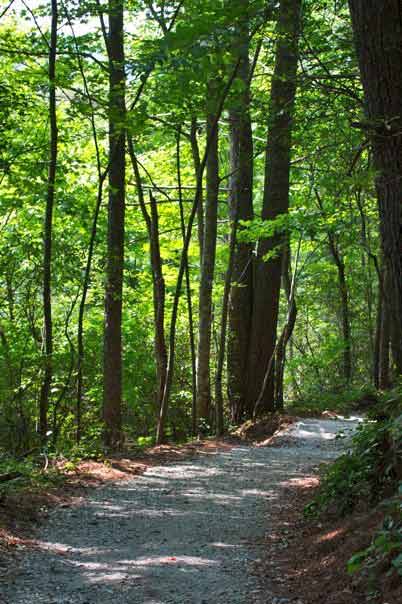
mountain path, shady and greenPsalms 119:1-24
Psalms 12, 13, 14
Isaiah 2:1-11
Luke 20:19-26

Finding a path you believe God wants you to walk on can be a difficult endeavor, relying on countless factors. In our world of constant movement, it behooves us to take moments of stillness to consider both our journey and our destination. In the Scriptures for today, paths of righteousness and wickedness are described fitting the time in which they were written. Consider, what would make a path of righteousness or a path of wickedness for you in this time? Sometimes we can get swept up in our goals that we don’t realize the beauty of the passage or we try to force our way ahead like the teachers of the law in Luke, searching for a particular goal rather than allowing a more loving path to guide their way. Take time to imagine your path and meditate deeply on the many steps along the journey. What will they look like? How might you feel at each step? What if you get turned around, how might you learn from that experience and what will follow it? Consider the photo and take time to imagine what each small step on the way represents for you as well as what lies beyond the bend…

***

Kelley Wheat-Rivers earned her masters degree in Pastoral Care and Counseling from Claremont School of Theology. She is now a Chaplain and Bereavement Coordinator at Liberty Hospice and a member of the Unitarian Universalist Fellowship, both in Wilmington, NC.


Becoming Mothers / Parents

In some ways the beginning of Advent is an ode to Parents. The women becoming mothers, the men bearing their own visions and dreams. But Advent does bring that focus on the women becoming mothers.

In I Samuel 2:1-10 we read about the story of Hannah. Hannah was a woman of God who prayed with fervor for her barren womb to be opened, and she became the mother of Samuel, the Prophet and Judge who would anoint David King. In fact the passage of 1 Samuel 2:1-10 is often called the Song of Hannah. It is a text of longing for the child within, and the model text for another passage famous this time of year.

In the tradition of Hannah, we find in Luke 1:46-55 a very famous text often called the Magnificat. It is a text of Mary – soon to be a mother herself – expressing her gratitude in a psalm of praise to God. Her hope, though, was not just for herself and for her unborn child, but for all people… for all generations. Her hope was for a time when oppression and scarcity would be a distant memory. Through our singing of the songs and telling of the stories of Mary’s little baby, who became Jesus of Nazareth – our brother, teacher, and Christ – we keep hope alive. We hope for the continued fulfillment of the promise, when justice and deliverance will be realized for all of Creation. “A light shines in the darkness, and the darkness cannot overcome it.”

PRACTICE: We invite you today to look at these texts so foundational to the Advent season. Ponder them deep in your heart and soul. We invite you to write your own hymn of praise to God, a praise that acknowledges the coming of Jesus at Christmas which we anticipate this Advent Season. If writing a unique praise to God seems to daunting…then you are invited to re-write the Magnificat from Luke’s gospel in today’s language—who are the downtrodden today? Can you name them in prayer to God?

Today’s devotional is a collaboration featuring the thoughts and words of Rev. Mary Jo Bradshaw and Rev. Kelli Parrish Lucas. Both of their bios can be found on the bios page.

Immaculate Conception for All

What good is to me for the Creator to give birth to his Son if I also do not give birth to him in my time and my culture?

—Meister Eckhart

It so happens that, in a mother-to-be’s womb, the amniotic fluid is changed every three hours, or five times every 24 hour cycle. This is one reason Muslims pray five times a day. The Immaculate Conception, therefore, is not limited to Advent. Each day, we are invited to tend our wombs: to grow the seed of the Divine within, to labor with the Divine as we give birth to our True Nature and, to celebrate, cherish and honor all that arises as we discern our Right Lives. Joy to the World! This practice is not just for Mary; it’s for all of us! And our future is shaped by how each of us heeds this daily invitation to joyfully, authentically BE Born. Let every heart prepare Him and Her room!

***

Rev. Lauren Van Ham is an interfaith “Eco-Chaplain” who has worked in a range of for-profit, non-profit, interfaith ministry, and environmental advocacy capacities. She is now the Dean of Chaplaincy at the Chaplaincy Institute in Berkeley, CA. Lauren is the featured guest in episode 16 of The Common Good Podcast where she talks about her calling and work. See Lauren’s website for more.

Advent Arrives With Many Colors

Having just returned from our Second Annual Thanksgiving trip to Death Valley National Park, I am filled with awe for God’s creation and even more so for God who had created all of these wonders.This year we went to the North end of the park to see things we had not yet seen. Death Valley is a wonderous and marvelous place. There are few spaces left in which human beings sense their smallness in the scheme of creation. The land scape of Death Valley is LARGE to say the least, and every ten miles or so it seems that you are in an entirely new ecological or geological setting. It is here where I go to be reminded not just of my smallness so I can regain perspective on life and ministry, but it is here where I can go to be reminded of my belovedness in being a creation of God myself that I am here to live my life emersed in the beauty that permeates Earth.

One of my favorite places in Death Valley is call The Artists’ Pallete. It is a mountainous region of the overlooks the salt flats that characterize Death Valley. There is something special about these mountains though. The geological processes that formed them included a period of hot water~I’m not a geologist I can not say much more~and this hot water brought to the surface all types of minerals not normally found on the surface of rocks. The result is about a mile-long stretch of mountains that vividly show all the major colors of the artist’s pallete–green mountain, blue mountain, gold mountain, pink mountain, red rock, and purple mountain. (We can not forget the purple, as my husband said it was made for me). The sight of the colors of these rocks and knowing that they are not painted but CREATED that way, simply makes me happy beyond belief! Yes, as an art professor once pointed out: I love colors, big bright vibrant colors! So when I see something like this, how can I not think that God loves me? How can I not see that God has made a place for me? How can I not envision a happy creating God with a host of Angles at God’s side having a great time creating such colors in the rock? How can I not celebrate the fact that two or three hymns are almost always circling through my head anymore and my soul can not keep singing the praises of God, whether I am having a good day and want to or not?

Creations such as this remind me how precious each of us are to be here, beloved and beloved, in this creation of God’s handiwork. It reminds me how God has been present, is present with, and may still be coming to be present with each of us in this creation. God is coming! …That is what the landscape clearly declared to me today. God is coming with a flourish of color and light and it is bound to be something not seen before for sure!

It is the start of Advent. God is coming! As the days grow shorter and darker with the changing of the seasons we need not have any fear for we are beloved children of God and God has created this world to hold us and support us, if we can only trust enough to that–but that’s another blog. For today let us know we are loved, that God has prepared a world for us to teach us how to be in awe, and that God is coming anew to greet us in this new season of the church, in this new season of the year, and in every changing season of our lives!

Welcome to the Women Who Speak in Church Advent Devotional, and yes for you loyal onlookers, you may have noticed, WWSIC has been playing with colors as well. We hope you will enjoy the Advent look of our blog this season.

The Peace of God Be with You.

Of Apples, Honey, and the Sound of Shofar

L’ shanah tova!

This is the traditional Hebrew greeting for the Jewish New Year.

As one of the founders of Women Who Speak In Church, I would to wish all my Jewish and Rabbi friends “L’shanah tova“! Yes, here at WWSIC we are not only ecumenical, but for those of us who are chaplains we are interfaith as well!

I can not pretend to present a Jewish understanding of the Jewish New Year, but I can share an experience I had some years ago related this day. At the time I was working as a program coordinator for a Jewish Senior Center. I learned a lot through working in that position, a briefly as I did. But I will not forget the day we took several seniors, some of who no longer drove, to the local lake to participate in the ritual practices related to the Jewish New Year. It was a nice sunny day that year and the local Orthodox Rabbi joined us for the ritual of Tashlikh or “casting off”. My understanding of the ritual is that the Jewish New Year brings a time of casting away the old and welcoming the “sweet” New Year. The Jewish practice of Tashlikh  is one in which individuals write their sins down and then cast them into the water. My experience of seeing the Tashlikh practice first hand touched me because so often we forget to let go of the sins in our past and as human beings we have a tendency to pull those things forward with us until they weigh us down so much that they are holding us back. Being so weighed down by the past that one can no longer move forward is something I encounter as a hospice chaplain. So to know that there is a religious practice that ritually helps us let go of the past intrigues me.

Last night at sun down, marked the beginning of the Jewish New Year. A holiday marked by letting go of the past. A holiday celebrated traditionally by dipping apples in honey to taste the sweetness of the New Year, and the blowing of the Shofar in the synagogue. A holiday that may have a lot to teach us all–regardless of our personal religious traditions.

So happy New Year to all our Jewish and our Rabbi friends. May this day be a sweet new beginning for us all!

The website holiday2.htm was consulted in composing this blog.

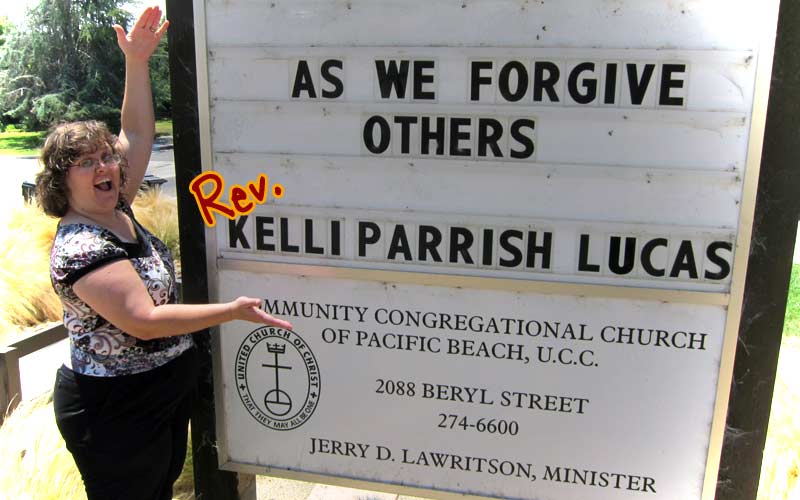
As We Forgive Others—Rev. Kelli

Rev. Kelli mugging at the marquee at church with her name on with "rev." painted in after the fact

Uh, that's "Rev." if you please...

Kelli just delivered her first sermon since being ordained in May. It was delivered at CCCPB on August 14th. Since it ran past YouTube’s 15 minute rule, it had to be cut into two, and at least at the time of posting, this is how we gotta do it. Back at YouTube, you can view it as a slightly more graceful playlist that will auto play in series.

Rev. Kelli looks at food insecurity in the time Joseph, a Hebrew in Egypt, and the dire situation in Africa (and lots of places) today, and introduces the UCC Mission 1 campaign.

Why That Color?

You may have noticed that the backdrop of our site has been changing periodically. This is not because we are simply bored, or even just in a flurry of redecorating. We have been changing the background of this site to reflect the liturgical colors of the Christian Year. Not all churches do this, I know, but many do and we thought it would be fun to do on this site as well. If you have ever noticed the seasonal changes in Creation well, then you know that God likes to redecorate from time to time–and so do we here at WWSIC!

The green is up for Ordinary Time, hope you like it. It will be here for a while.

Thoughts on Being Ordained

So I have been ordained for nearly three weeks now. Some have wondered why I haven’t written about this sooner. Well there is the rub. Ordination, while often seen as a destination along the journey to that point, is really just a beginning—the beginning of the work of ministry; the beginning of trying to keep up with God. I was trying to keep up with God before, yes, but truly the last three weeks have been a whirlwind seemingly stuck on fast forward, as it’s going to be a while before things re-approach “normal” speed. God seems to be running a marathon with me as of late! And that’s all okay with me!

God is not only difficult to define or describe, but God is beyond all our definitions and expectations! Just when you think you understand God, God shows God’s self in ways and what you can not understand. God is ineffable. This is part of what I tried to convey in my ordination paper when I termed God a Trickster. I’m so glad Rev. Jerry Lawritson mentioned that in the sermon at my ordination. Ever hear of the yoke of Jeremiah? But, I digress. Or perhaps not.

There are some things about being ordained that I did not expect, and some moments in being ordained that carried great meaning. I’ll speak to the latter. I have to say that one of the unexpected moments of my ordination that continues to carry great meaning was the laying on of hands. I am not going to go into the politics of ordination here, but suffice to say that after all the trials one goes through in “proving” they can meet the requirements of ordination and early ministry, for me—particularly as a disabled woman, reared in poverty, who has been made to feel “less than” most of her life—to hear the congregation say “Yes she is worthy, let us ordain her” and then to see local clergy immediately get up, hover over and encircle me was overwhelming! It was empowering. It was a confirmation that boosted my confidence. And at a certain level it was also a great relief for here I was exactly where I had known for so long I was meant to be AND the community and the clergy acknowledged it! Even if, at the same time, it seemed at some level that it was late in coming, it truly felt meaningful, a moment of awe for me. It was not the confirmation of my call—for what human acts, no matter the ritual history or intent, can confirm the call of God? But it felt as if God was jumping up and down, celebrating because the community “got” the call. It felt like an act of God. And I still feel the awe.

Ordination is worth struggling for. I understand this now in a much more profound way. In churches where women, GLBT, persons with disabilities are not eligible for ordination, ordination is worth struggling for because the call to ministry is not a call of the Church, but a call from and an act of God. For my friends who continue in the ordination process, to friends who have newly received their Masters of Divinity and seek to serve, to the Rev. Elvin Harrison who seeks privilege of call in the UCC tomorrow, to seminarians with disabilities who faithfully struggle to follow their call when the possibility of ordination still seems a hazy dream come to oppress them from a heavenly land let my ordination be an encouragement to you…yes, your ordination is worth struggling for, especially when it seems it might require an act of God! God is with you.