Waiting on the Lord

Backstory

Two years ago, when I wrote this, I found myself in a very fearful waiting place. I was without a job, without any prospects, and with the knowledge that my money would soon run out while in California. It was nearing a time when I would need to pack my bags and head back to the East Coast to begin again. This was the very last thing I had wanted to do that that time.

Waiting on the Lord

Waiting on the Lord? I suck at it.

Yes, for all the times I’ve sat with families and patients waiting for a test result, a surgical outcome, pain medicine, a trauma doctor to come and give some news—for all the times I’ve prayed for God to make me a peaceful presence, a non-anxious presence, when my life is on the line, more often than not, I crack.

And that’s okay.

My goal here is not to chastise myself over ‘cracking’ or my impatience or my misguided thinking that I can tackle the problems of the world (or at least my little world) alone.

I’m here to wrestle with this—it’s usually in this wrestling, this struggle (la lucha) that God most clearly speaks to me, and hopefully to anyone else who needs to hear what He has to say.

I’ve wanted to write this, to struggle with this waiting on the Lord since Monday night, as I drove home from my friend’s house.

The anxiety that I had fought so hard to keep at bay crept up and took me by surprise. Two weeks and I may be packed up and heading back East! The thought gripped me by the throat and squeezed, hard! Now, to those in the Northeast, I’m also not writing this to do a whole East vs. West comparison or to say one sucks and that the other is perfect. This is not what this is about.

So this thought is choking the life out of me and I’m way past panic mode when—finally!—I remember. My life, my future, my everything is in God’s hands. One would think that this new thought would tear me from the hands of despair and bring me some relief. Not quite so. Not yet, at least. I think my dialogue with the Almighty went something like, “Oh my God, no. Really?” “Really, I’ve got this. It’s all okay.” Except it wasn’t. I knew it wasn’t okay. I was and have been scared shitless, sleepless and at times grumpy at others. Sorry Mom, Dad, and [insert your name].

It was anything but okay.

Still, in my own infinite wisdom (laugh here, please), I pushed on. “I can do this. No worries. It’s all under control,” which of course it wasn’t, and I was slowly driving myself insane. Everything is in God’s infinitely capable hands.

‘But I’m scared,’ I heard myself whisper.

Of course, I’m scared. It’s scary. Uncertainty and a looming unknown are both scary potentials. Words to many songs came into my heart. Knowing that giving voice to these, and to the prayer that was in the song, would make me emotional, I found myself resistant at first and I also knew that surrendering my heart, my soul, my hopes, and my fears to God was the very best thing for me. I also remembered that “throughout the day we may need to surrender our will repeatedly. This can be especially true while struggling to let go of expectations” (Opening Our Hearts, Transforming Our Losses, 46). And what was I in need of doing but letting go of expectations and outcomes in regards to my job search and my drive to stay in California?

I sang, I prayed. I pranged. I did it honestly, openly, and vulnerably. And yes, there were tears. First came the worship song, “The Everlasting God”:

Strength will rise as we wait upon the Lord
We will wait upon the Lord…

—But I don’t want to!

We will wait upon the Lord…

— But I don’t have time to!

And again, until all my fearful resistances were silenced. Until I pranged it right through:

Our God, You reign forever
Our hope, our strong deliverer
You are the everlasting God
the everlasting God
You do not faint
You won’t grow weary

The words came and suddenly my history of waiting, my history of being delivered, was before me. Call it a documentary of God’s salvific work in my life running through my head, my heart, and my soul. A strong witness that God—the one holding my life, my everything in his hands—is indeed the defender of the weak, the comforter of those in need and the one who will lift me, and all of us, on wings like eagles’.

I felt my heart change. I felt secure; surrounded by the love of God and as I was changed, so changed my song:

I have decided,
I have resolved,
to wait upon You Lord.

It is the only thing I can do. It is the only thing I can ever do, and when the waiting is difficult, when it feels impossible, I can ask God to help me. The song/prayer (sayer?) goes on:

My rock and redeemer,
shield and reward,
I’ll wait upon You Lord.

I will wait with the help of God, my rock. I cannot do it alone. I cannot do anything alone. It’s foolishness for me to think that I can, and yet I know I will think so again and again (and again). And again I will need to ask God for help; I’ll ask for God to dim the lights and roll the film, allowing that glorious documentary to play on a larger-than-life screen. Except this time a clip of me in my car, wrestling as I turned onto the southbound Interstate 15; tearful, fearful and resistant, will have been added, as will the song of my heart rising high to the heavens and the everlasting God’s graceful, merciful response.

As surely as the sun will rise
You’ll come to us.
Certain as the dawn appears,
You’ll come.
May it be so.

Epilogue

Oddly enough, I got home that night, checked some random job postings and stumbled across something I had never seen before. I applied the next day and am going to be arranging for an interview on Monday. Thanks to all those who have kept me in prayer! And now, two years later I remain in California, have that job that I found that night, remain relatively impatient and still struggling to wait on the Lord, but I have another memory of God’s hand in my life to turn to when the waiting begins to be too much.

God came then in this reflection, that very night even!

God is coming to us in this holy season.

God will continue to come to us in all our needs.

***

Donna Batchelor is a hospice chaplain and youth pastor in San Diego County, CA.

Stop. Look. Listen.

shining flowers in the sunlight

Psalms 24, 29, 8, 84
Isaiah 42:1-12
John 3:16-21
Ephesians 6:10-20

Take heed of the old adage for crossing the street: “Stop. Look. Listen.” Three simple directions that can assuredly help you see the glory that is around you! Finding what stirs your soul and reconnects you to your sacred center is as individual as a fingerprint. The Scriptures for this day in the advent season are dripping with awe and longing for the beauty and promises of God. What fills your spirit to its brim? What makes you want to sing out joyfully with a huge grin on your face? Imagine it and then send out your praises to the Divine! Share beauty, glory, and gladness in this sparkly season of Christmas! A season that reminds us that God is with us. Advent represents God’s light entering into our darkened world. We should smile and allow that light to fill our days, bless our interactions with others and spread warmth to all we encounter.

***

Kelley Wheat-Rivers earned her masters degree in Pastoral Care and Counseling from Claremont School of Theology. She is now a Chaplain and Bereavement Coordinator at Liberty Hospice and a member of the Unitarian Universalist Fellowship, both in Wilmington, NC.

Waiting

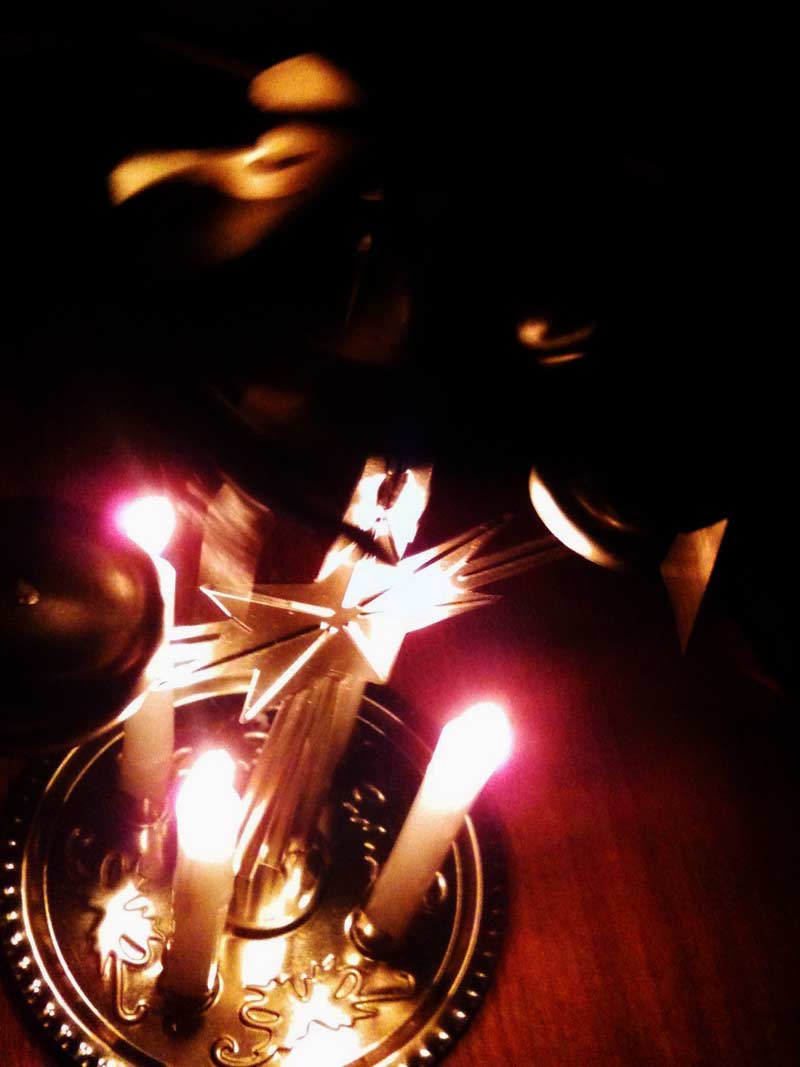
almost top view of fancy liturgical candles on a gold mount.Waiting. Waiting. Waiting.

All this waiting.

I’m tired of waiting.

And here I find myself in an entire season of waiting.

I’m tired of waiting for friends and family to find jobs.

I’m tired of waiting for the housing market to rebound.

I’m tired of waiting for the country to stop arguing about divisive issues with derogatory discourse.

I’m tired of waiting for my denomination to stop fighting to its death over who gets to be a minister and instead start ministering to the wounds of the world—including the ones we ministers have caused.

I’m tired of waiting to find time for ritual artistry, mission vision and sermon creation at the end of the week after the administration and budget balancing work is done.

And now, in this season of waiting and anticipation of the beautiful light of Christmas, it seems there are even more things both to do and to fail to do, more finances to worry about, more details to manage and more necessary distractions.

When did we change from the children who couldn’t wait for Christmas to arrive to the adults who can’t wait until Christmas is over?

How is it we find ourselves hurtling toward the Holy Child each year as one more task to get past?

Just wait until next Christmas, we promise ourselves, it won’t be this way next year!

But why wait?

Start now, with 12 days left until Christmas Eve.

Reclaim THIS Christmas right now.

There really is no need to just wait until next year.

Pause a moment now, yes, wait just a moment, and consider what most evokes the holy to you in this season. Spend another moment and let yourself be surrounded by that particular sense of the holy.

Now, in the 12 days that remain, consider one life-giving activity or tradition or memory from childhood or years past, and find another moment or two to remember it or even reclaim it.

One year, for me, this was to open a set of angel candle chimes from their 99-cent box, build them, light them and watch the angels spin from the rising heat of the candlelight. The table they were on was a mess, but I didn’t care. All I saw was the light and motion, and I heard the faint sound of a Christmas long past that became Christmas present.

What in your church, what in your home, what in your heart would give you a holy moment?

In each day, in those odd moments of reflection or even concern, pause to consider the holy.

Pause to surround yourself with a holy memory or create a holy moment.

Pause with the hope and prayer that come Christmas Eve, your season will already be filled with holy remembrances, holy moments and holy light.

Welcome the Holy Child with your heart already filled with a sense of Divine presence in your life.

We wait each year for the celebration of Divine Light in our lives, yet there really is no need to wait.

The Holy Light shines already.

Divine Creator, in this season of anticipation, guide us toward our hopes for the future fueled by our fondest memories of the past. We pause in prayer and in hope that in any moment time expands to fill with the Holy Light of Divine Love. In your most holy names we pray, Amen.

***

Rev. Karen Clark Ristine is a minister at Mission Hills United Methodist Church. After more than 20 years as a journalist, she entered seminary in 2006 and has been working in ministry ever since. After a lifelong tradition of sending out scores of Christmas cards each year, she was surprised to discover the irony that, as a minister, she no longer seemed to have time to continue that tradition. 

Divine Partnering

They love to have the place of honor at banquets and the best seats in the synagogues, and to be greeted with respect in the market-places, and to have people call them rabbi. But you are not to be called rabbi, for you have one teacher, and you are all students.

—Matthew 23:1-12

What drives our actions? Jesus points to the scribes and Pharisees saying (paraphrased) “do what they teach and not what they do.” Jesus says that the teachings may be in the right place, but not their hearts. What compels them to share wisdom? In this text, we are introduced to people who do work for their own desires including taking places of honor and prestige in the community.

There are a number of actions we take to better ourselves. Giving our time, talent, and treasure to important causes feels good. There are also times we take action because it makes us look good or makes us feel better about ourselves.

I entered college and graduate school to strengthen some of my skills and increase my knowledge so that I could make a bigger contribution to the world—but that wasn’t the whole reason. I discovered that deep inside I was hoping that I would somehow attain deeper respect from others and feel better about my place in the world. I was also feeling a bit insecure about being a lesbian woman entering the ministry. My feelings became more apparent when I heard the story of a local college professor who was called an epithet based on his sexual orientation when all he wanted to do was share a drink with friends. I was saddened to hear of the event and realized that even if I had the letters “Rev.” or “Dr.” in front of my name, I would not be shielded from harm. I was going to school, in part, because I thought my education could protect me. The truth is that if I desire to do what is right and honor God, I am choosing a challenging path. The lives of Jesus and the prophets show us all too clearly how those who carry the message of love and peace are not always readily received.

We cannot do this work alone. Because of this, we cannot expect to take all the credit, either. This work of honoring God with our lives requires nothing short of the power of God acting in and through us.

God gives us a glimpse of the peaceable realm when those who wish to store up all the glory for themselves will be humbled and those who are humbled will be celebrated. It is when we are most humble that we are able to truly experience peace and witness the power of God.

Oh God, it is said that I must decrease in order for you to increase within me. I pray that desires for my own will may decrease that I may discover how the unique gifts you have freely given me can be fine tuned to live out your will to bring about the peaceable realm. Amen.

***

Angela Henderson, M.Div. currently serves as the Unitarian Universalist campus minister at UC Davis. She graduated with her Master of Divinity degree from Claremont School of Theology in 2010 and is a candidate for ministry.

Waiting, Watching

When I was in elementary school I loved Fridays. Not only was it “tater tot day” in the cafeteria, but every Friday we played dodgeball during PE. Dodgeball was one of my favorite games; running, jumping, and yes, even the occasional opportunity to throw a ball at your classmate! (You know the one!) However, one of the best aspects of dodgeball was even when you were “tagged out” and having to wait on the sidelines, if your teammate caught an opponent’s ball your teammate could choose to have you come back into the game thus giving you a “do-over.” What I have learned in life as well as in dodgeball, is that the waiting can be hell. How absurd then that Advent, a whole season in the Christian tradition, is about waiting.

Like most seminarians I was coerced into studying biblical languages; it was just one of the many gifts of seminary. Through all the blood, sweat, and tears studying these languages caused me, I learned to love and value the original meaning of each intended word. For example, the words for waiting in both Greek and Hebrew are used at times as synonyms for watching. To make things worse, both languages suggest an attitude for which these two verbs should happen—both positive. Excuse me, but I am a child of the 80s. My generation has never known life without a microwave! We don’t wait well. According to the biblical languages, I am told not only to wait, but to be positive about it! It was one thing to wait on the sidelines as a kid, but as an adult? Come on! Let’s just be honest: waiting is about being in transition and transition can bring up a multitude of feelings, most of them unpleasant!

Over the last three months I have had a crash course in waiting, watching, and attitude adjustments. After almost a year of prompting by Spirit I did it; I quit my job, packed my stuff, and moved me and my dog to the great state of Washington in order to pursue more education. In my head I expected everything to be nicely wrapped and just waiting on me—after all, I did what Spirit prompted. I knew things would eventually work out, but did not expect to be waiting on a job, especially in this economic climate. As you can imagine, as the days passed with no calls of offers the fears grew and the questions began to surface. The questions soon led to deeper questions which I now see was part of the watching/preparing. The time I was able to dedicate to these questions has had a profound impact on the way I will go about my future work and practice. I almost missed it because I was too busy grumbling, complaining, and cursing at God about the waiting and so I forgot to participate in the watching. What I have learned (or maybe re-learned) is that the gift of waiting is the watching. Watching is finding God in the present even when the present is filled with uncertainty. Watching is our part; our participation which we do by asking the questions and going ahead by preparing ourselves as if that for which we are waiting is already here.

This year, my Advent is remembering that no matter how much I think I know what I need, God knows more. God is more creative than my wildest dreams, and when God insists that I wait, it is for a reason! My job offer did come and once again I was humbled and in awe not only because of the job itself, but because of the details that are so tailored to my situation—this job was created for me. If you find yourself like me, questioning and doubting while waiting, watch for the gift within the present and remember, God is always on time.

Contemplation

mountain path, shady and greenPsalms 119:1-24
Psalms 12, 13, 14
Isaiah 2:1-11
Luke 20:19-26

Finding a path you believe God wants you to walk on can be a difficult endeavor, relying on countless factors. In our world of constant movement, it behooves us to take moments of stillness to consider both our journey and our destination. In the Scriptures for today, paths of righteousness and wickedness are described fitting the time in which they were written. Consider, what would make a path of righteousness or a path of wickedness for you in this time? Sometimes we can get swept up in our goals that we don’t realize the beauty of the passage or we try to force our way ahead like the teachers of the law in Luke, searching for a particular goal rather than allowing a more loving path to guide their way. Take time to imagine your path and meditate deeply on the many steps along the journey. What will they look like? How might you feel at each step? What if you get turned around, how might you learn from that experience and what will follow it? Consider the photo and take time to imagine what each small step on the way represents for you as well as what lies beyond the bend…

***

Kelley Wheat-Rivers earned her masters degree in Pastoral Care and Counseling from Claremont School of Theology. She is now a Chaplain and Bereavement Coordinator at Liberty Hospice and a member of the Unitarian Universalist Fellowship, both in Wilmington, NC.


Immaculate Conception for All

What good is to me for the Creator to give birth to his Son if I also do not give birth to him in my time and my culture?

—Meister Eckhart

It so happens that, in a mother-to-be’s womb, the amniotic fluid is changed every three hours, or five times every 24 hour cycle. This is one reason Muslims pray five times a day. The Immaculate Conception, therefore, is not limited to Advent. Each day, we are invited to tend our wombs: to grow the seed of the Divine within, to labor with the Divine as we give birth to our True Nature and, to celebrate, cherish and honor all that arises as we discern our Right Lives. Joy to the World! This practice is not just for Mary; it’s for all of us! And our future is shaped by how each of us heeds this daily invitation to joyfully, authentically BE Born. Let every heart prepare Him and Her room!

***

Rev. Lauren Van Ham is an interfaith “Eco-Chaplain” who has worked in a range of for-profit, non-profit, interfaith ministry, and environmental advocacy capacities. She is now the Dean of Chaplaincy at the Chaplaincy Institute in Berkeley, CA. Lauren is the featured guest in episode 16 of The Common Good Podcast where she talks about her calling and work. See Lauren’s website for more.

Calling Forward the Ways of Church: A Woman Named Virgina Kreyer

Today is “Access Sunday” in the UCC, a day for celebrating the inclusion of people with disabilities in our congregations and denomination. In honor of this day I am posting this bio of Virginia Kreyer which I wrote some years ago for a polity class. Here is to all those who work to widen the welcome of our churches.

a photo of Virgina Kreyer

Rev. Virginia Kreyer was more than a pioneer of her time; and today she is one of the heroes within the UCC tradition. As Kreyer would likely urge me to point out, she is not a hero because of the circumstances of her life, rather she is a hero because she called upon our denomination to examine its own participation in unjust systems and in so doing, called the UCC itself to change. Kreyer was a social activist, and the UCC would not have the same social commitments that it does today if she had not spoken from her unique perspective for change. To speak about social issues in her own voice required not only great courage from Kreyer but that she also use her own story as a tool for explaining the need for and way to change. For this, Kreyer has been called a pioneer as well as a prophet (“Virginia Kreyer Award” and “Reverend Virginia Kreyer Named Antoinette Brown Woman”).

Virginia Kreyer was born in 1925, and “[d]ifficulties at her birth . . . resulted in cerebral palsy at a time when the condition was little understood” (“Alumni Books: Virginia’s Story”). At that time, cerebral palsy (CP) was not a disability often seen openly in society; yet, rather than hide Virginia and cater to her needs, her family was bold in their approach to raising her. It has been noted that: “Virginia’s mother was pivotal in how Virginia became who she is. She never allowed her daughter to use her disability as an excuse. Believing that a disability is not something you hide, she imbued Virginia with her quality of dogged persistence” (“Reverend Virginia Kreyer Named Antoinette Brown Woman”). While Kreyer had family support, it often requires more for those with CP to thrive in a world that does not understand what it means to live with the challenges CP. Gay McCormick, UCC DM representative to the Office of General Ministry, has pointed out that “[t]o know the importance of [Virginia’s] qualities it is necessary to understand that she required years of physical and occupational therapy as well as extensive speech therapy, and, that as a child, she was perceived as mentally retarded because of her speech” (Ibid). Fortunately, this perception was one that Kreyer would surpass as she grew physically, intellectually, educationally, and professionally.

Kreyer thrived in her life and her education. However, it was not only Kreyer’s family who inspired her to thrive. Kreyer’s “faith in God inspired her as well. She once said, [that] ‘those who have accepted their handicaps and triumphed over them are those who have learned to look beyond themselves for help and learned of the ways of the spiritual world’” (UCC Vitality). It was a spiritual lesson she learned early, yet that would not make her journey any easier. In Kreyer’s “high school and college days she had felt God’s call to work in the church. It was a call to make this world a better place in which to live, but ‘Who would ordain a ‘handicapped” woman?’ the writer of her nominating letter said” (“Reverend Virginia Kreyer Named Antoinette Brown Woman”). It was a good question in the 1940 and 1950’s. It was a question that Kreyer would answer. “A year after Virginia graduated from college she became a student at Union Theological Seminary in New York, but not before her first application for admission was rejected. With the assistance of clergy and Union faculty who supported her, she was admitted as a full-time B.D. (now M.Div.) student” (Ibid). As a disabled woman, Kreyer had to fight to even get into seminary.

Kreyer was ordained first, in a denomination other than the UCC (unclear which one), after her graduation from UTS. At that time, she went to work, hoping to be a chaplain, for the Nassau County (NY) Cerebral Palsy Center where she worked until 1984. However, it is said this center had intended for Kreyer to be a role model to others of what was possible for persons with CP; Kreyer was not happy with this and started a Masters of Social Work program, which she completed in 1960. (Ibid.)

In the ten years between 1967 and 1977, Kreyer would begin to step into her call to a ministry that would make the world a better place to live. “In 1967 she began attending Garden City Community Church, a UCC congregation, becoming a UCC member in 1971. Then she began a long process of being ordained in the UCC” (Ibid). It was during the process of transferring her ordination status to the UCC, that she commented to her ordination committee in New York on the need for “beginning of a committee for persons with disabilities called handicapped / physically challenged” (Ibid).

Kreyer may not have been asking for a new job, but she had it. After five frustrating years of trying to get her association to address the needs of people with physical disabilities, it was suggested to Kreyer that a resolution be presented to the New York Conference at their next meeting. Not only did the New York resolution pass in 1976, but it was forwarded for action to the 1977 Synod (Ibid). Both Rev. Virginia Kreyer and Rev. Harold Wilke (born without arms) gave moving speeches urging the 1977 Synod (UCC Vitality) to endorse “ministry to and with persons with disabilities” (“Reverend Virginia Kreyer Named Antoinette Brown Woman”). It was a defining moment for both Kreyer and the UCC. Kreyer accepted the 1/5th time consulting position with the denomination that this resolution created; in this position, she assisted local churches in learning how to become accessible and welcoming to people with disabilities. This work made Kreyer the first leader of what has come to be known as the UCC Disabilities Ministries (UCCDM).

Kreyer’s advocacy for people with disabilities was not limited to the UCC. “In 1991 she attended the Consultation on the Disabled in preparation of the World Council of Churches (WCC) and then served as a UCC delegate to the World Council, working on issues of disability rights”(Ibid). Kreyer also served as  “a member of the National Council of Churches of Christ (NCCC) Committee of the Disabled, and then a member of the Board of Directors, 1977-1995” (Ibid). Kreyer retired from service to the UCC in 1995. (Ibid).

Kreyer’s work within the UCC will be long remembered. At the Synod in 2001, a new award known as the ‘Kreyer Award’ was announced to recognize persons who “have shown a pioneering spirit in the work of the UCCDM” and “leadership inside and outside the church and furthering the day when persons with disabilities will be full partners and contributors within church and society” (“The Virginia Kreyer Award”). Kreyer was the first person to receive the Kreyer Award. In 2007, Kreyer was given the high honor of the UCC’s Antoinette Brown Award, reserved for distinguished and ordained UCC women (“Reverend Virginia Kreyer Named Antoinette Brown Woman”).

Rev. Virginia Kreyer’s work in advocating for the opening of all the churches to all of God’s children with disabilities has been felt and discussed, literally, around the world. Kreyer not only sent out the call for the UCC to change but she used her own journey-story, to create the change that she needed to see in the denomination and the world. It has been said that Kreyer was “a rare human being whose faith and witness has inspired the UCC to extend an extravagant welcome. Her welcome embraces all people, but especially those with disabilities of any kind” (UCC Vitality). Doors have been opened, that cannot be shut. The UCC will never be the same, thanks to Rev. Virginia Kreyer, the woman who did!

I Used To Be A Murderer

Yes, that’s right: I used to be a murderer. That probably comes as a shock to most of you. I mean, this is Pastor Mary Jo, champion of non-violence and believer in the holiness of all life–Pastor Mary Jo, who doesn’t even eat meat, for crying out loud! Besides, how can someone who was a murderer stop being one? Once a murderer, always a murderer, right?

Let me tell you a story. It could be a parable or a fairy tale… but it isn’t. It really happened, but because it involves people who probably don’t want their personal business bandied all over the internet, and because the details aren’t important, I’m only going to tell you that I was convinced that someone was such a threat to my family that I designed a detailed plan to commit murder if I thought it necessary.

I knew that even contemplating murder was sinful. I knew that it would cause God sorrow, that it would tear my family apart and cause them even more hurt. I knew that I would either be killed myself or go to prison for a very long time; I was willing to pay the price–even though I knew how evil it was.

Fortunately, that “someone” disappeared from the picture and I came to my senses in pretty short order… although I can’t say for certain which came first, his departure or my repentance.

The point is I am not the same person I was when I plotted to take a human life, the life of someone who had value as a child of God and who had people who loved him every bit as passionately as I loved my family. I am not even the same person I was when I felt angry at my spouse earlier this week.

You have heard that it was said to the men of old, ‘You shall not kill; and whoever kills shall be liable to judgment.’ But I say to you that every one who is angry with his brother shall be liable to judgment; whoever insults his brother shall be liable to the council, and whoever says, ‘You fool!’ shall be liable to the hell of fire.
(Matthew 5:21-22, RSV)

People who physically commit murder have a possibility of being rehabilitated. In the years that follow sentencing an individual may come to realize the wrongness of what they’ve done, to repent, to “find God, ” to become a better person, to grow. As the Apostle Paul wrote, “When I was a child, I spoke like a child, I thought like a child, I reasoned like a child; when I became a man, I gave up childish ways. ” (1 Corinthians 13:11, RSV) When the switch is pulled or the poison injected all of that potential for positive change is destroyed.

Troy Davis may or may not have killed a police officer in 1989. Lawrence Russell Brewer was unquestionably involved in the brutal and racially motivated murder of a black man ten years later. What they have in common is that both were executed on September 21, 2011–one in Georgia, the other in Texas. Their deaths did not serve to resurrect the men who were murdered–Mark MacPhail and James Byrd, Jr. Their executions were not acts of justice; they were acts of retribution.

Thank God, I didn’t act on my sin of the heart. I had a chance to change, to grow, to contribute to the world in a positive way. With just a few different choices… it could have been me. I used to be a murderer.

I’m Afraid of Falling (So What Am I Doing in This Ivory Tower?)

Ivory tower rook piece from a chess setMy undergraduate degree is in Cultural Anthropology, and during my junior year of college an Anthropologist told us that the education we were receiving would very likely distance us from the people we would eventually work with. (Never mind any cultural or religious or economic differences!) I’ve carried that warning in the back of my mind ever since. Now I have a Masters of Divinity and I’m working on a Doctor of Ministry degree and widening the distance whether I want to or not. The problem is, I’m realizing more and more that the distance is not just between myself and the people I work with; it’s frequently between myself and the people closest to me … and sometimes I feel like crying.

Three days a week I’m surrounded by people who have high expectations for themselves and others, who have respect for people who are not like “us.” Three days a week I’m in the company of people who believe in nonviolence and interfaith dialogue. Outside the ivory tower of academia–and specifically religious academia–I often encounter people who think telling ethnic jokes and making fun of people with disabilities (in private, at least) is funny. I have to contend with people who think it’s okay to denigrate any religious beliefs that aren’t close enough to their own.

So what’s a “nice,” left-of-progressive, lady preacher to do? I know, I know—I should be prophetic and call people to account for their ignorance and insensitivity. I find that very difficult. I don’t want to be seen as the humorless religious fanatic, or jeered for being uber “politically correct.” I don’t want to be the “bitch” that spoils everybody’s fun. I don’t want people I love to avoid me. Yep–it’s all about me. And that’s the problem.

The disease of the self runs through my blood
It’s a cancer fatal to the soul
Every attempt on my behalf has failed
To bring the sickness under control [1]

I want to do the right thing. I want to stand up for justice. Really–I do. I also want to be compassionate, humble, nonjudgmental. So I sympathize with the Apostle Paul, who was moved to write, “For I do not do the good I want, but the evil I do not want is what I do.” [2] It’s a sin of commission and omission. I stand on the battlement of the ivory tower, knees shaking, trying NOT to look down… and paralyzed by fear. I want to do the right thing; I’m just not sure what the “right thing” is.

_____________________________________________________________

[1] Charlie Peacock. “In the Light.” Copyright 1991, Sparrow Records.
[2] Romans 7:19, RSV