Immaculate Conception for All

What good is to me for the Creator to give birth to his Son if I also do not give birth to him in my time and my culture?

—Meister Eckhart

It so happens that, in a mother-to-be’s womb, the amniotic fluid is changed every three hours, or five times every 24 hour cycle. This is one reason Muslims pray five times a day. The Immaculate Conception, therefore, is not limited to Advent. Each day, we are invited to tend our wombs: to grow the seed of the Divine within, to labor with the Divine as we give birth to our True Nature and, to celebrate, cherish and honor all that arises as we discern our Right Lives. Joy to the World! This practice is not just for Mary; it’s for all of us! And our future is shaped by how each of us heeds this daily invitation to joyfully, authentically BE Born. Let every heart prepare Him and Her room!

***

Rev. Lauren Van Ham is an interfaith “Eco-Chaplain” who has worked in a range of for-profit, non-profit, interfaith ministry, and environmental advocacy capacities. She is now the Dean of Chaplaincy at the Chaplaincy Institute in Berkeley, CA. Lauren is the featured guest in episode 16 of The Common Good Podcast where she talks about her calling and work. See Lauren’s website for more.

Advent Arrives With Many Colors

Having just returned from our Second Annual Thanksgiving trip to Death Valley National Park, I am filled with awe for God’s creation and even more so for God who had created all of these wonders.This year we went to the North end of the park to see things we had not yet seen. Death Valley is a wonderous and marvelous place. There are few spaces left in which human beings sense their smallness in the scheme of creation. The land scape of Death Valley is LARGE to say the least, and every ten miles or so it seems that you are in an entirely new ecological or geological setting. It is here where I go to be reminded not just of my smallness so I can regain perspective on life and ministry, but it is here where I can go to be reminded of my belovedness in being a creation of God myself that I am here to live my life emersed in the beauty that permeates Earth.

One of my favorite places in Death Valley is call The Artists’ Pallete. It is a mountainous region of the overlooks the salt flats that characterize Death Valley. There is something special about these mountains though. The geological processes that formed them included a period of hot water~I’m not a geologist I can not say much more~and this hot water brought to the surface all types of minerals not normally found on the surface of rocks. The result is about a mile-long stretch of mountains that vividly show all the major colors of the artist’s pallete–green mountain, blue mountain, gold mountain, pink mountain, red rock, and purple mountain. (We can not forget the purple, as my husband said it was made for me). The sight of the colors of these rocks and knowing that they are not painted but CREATED that way, simply makes me happy beyond belief! Yes, as an art professor once pointed out: I love colors, big bright vibrant colors! So when I see something like this, how can I not think that God loves me? How can I not see that God has made a place for me? How can I not envision a happy creating God with a host of Angles at God’s side having a great time creating such colors in the rock? How can I not celebrate the fact that two or three hymns are almost always circling through my head anymore and my soul can not keep singing the praises of God, whether I am having a good day and want to or not?

Creations such as this remind me how precious each of us are to be here, beloved and beloved, in this creation of God’s handiwork. It reminds me how God has been present, is present with, and may still be coming to be present with each of us in this creation. God is coming! …That is what the landscape clearly declared to me today. God is coming with a flourish of color and light and it is bound to be something not seen before for sure!

It is the start of Advent. God is coming! As the days grow shorter and darker with the changing of the seasons we need not have any fear for we are beloved children of God and God has created this world to hold us and support us, if we can only trust enough to that–but that’s another blog. For today let us know we are loved, that God has prepared a world for us to teach us how to be in awe, and that God is coming anew to greet us in this new season of the church, in this new season of the year, and in every changing season of our lives!

Welcome to the Women Who Speak in Church Advent Devotional, and yes for you loyal onlookers, you may have noticed, WWSIC has been playing with colors as well. We hope you will enjoy the Advent look of our blog this season.

The Peace of God Be with You.

Calling Forward the Ways of Church: A Woman Named Virgina Kreyer

Today is “Access Sunday” in the UCC, a day for celebrating the inclusion of people with disabilities in our congregations and denomination. In honor of this day I am posting this bio of Virginia Kreyer which I wrote some years ago for a polity class. Here is to all those who work to widen the welcome of our churches.

a photo of Virgina Kreyer

Rev. Virginia Kreyer was more than a pioneer of her time; and today she is one of the heroes within the UCC tradition. As Kreyer would likely urge me to point out, she is not a hero because of the circumstances of her life, rather she is a hero because she called upon our denomination to examine its own participation in unjust systems and in so doing, called the UCC itself to change. Kreyer was a social activist, and the UCC would not have the same social commitments that it does today if she had not spoken from her unique perspective for change. To speak about social issues in her own voice required not only great courage from Kreyer but that she also use her own story as a tool for explaining the need for and way to change. For this, Kreyer has been called a pioneer as well as a prophet (“Virginia Kreyer Award” and “Reverend Virginia Kreyer Named Antoinette Brown Woman”).

Virginia Kreyer was born in 1925, and “[d]ifficulties at her birth . . . resulted in cerebral palsy at a time when the condition was little understood” (“Alumni Books: Virginia’s Story”). At that time, cerebral palsy (CP) was not a disability often seen openly in society; yet, rather than hide Virginia and cater to her needs, her family was bold in their approach to raising her. It has been noted that: “Virginia’s mother was pivotal in how Virginia became who she is. She never allowed her daughter to use her disability as an excuse. Believing that a disability is not something you hide, she imbued Virginia with her quality of dogged persistence” (“Reverend Virginia Kreyer Named Antoinette Brown Woman”). While Kreyer had family support, it often requires more for those with CP to thrive in a world that does not understand what it means to live with the challenges CP. Gay McCormick, UCC DM representative to the Office of General Ministry, has pointed out that “[t]o know the importance of [Virginia’s] qualities it is necessary to understand that she required years of physical and occupational therapy as well as extensive speech therapy, and, that as a child, she was perceived as mentally retarded because of her speech” (Ibid). Fortunately, this perception was one that Kreyer would surpass as she grew physically, intellectually, educationally, and professionally.

Kreyer thrived in her life and her education. However, it was not only Kreyer’s family who inspired her to thrive. Kreyer’s “faith in God inspired her as well. She once said, [that] ‘those who have accepted their handicaps and triumphed over them are those who have learned to look beyond themselves for help and learned of the ways of the spiritual world’” (UCC Vitality). It was a spiritual lesson she learned early, yet that would not make her journey any easier. In Kreyer’s “high school and college days she had felt God’s call to work in the church. It was a call to make this world a better place in which to live, but ‘Who would ordain a ‘handicapped” woman?’ the writer of her nominating letter said” (“Reverend Virginia Kreyer Named Antoinette Brown Woman”). It was a good question in the 1940 and 1950’s. It was a question that Kreyer would answer. “A year after Virginia graduated from college she became a student at Union Theological Seminary in New York, but not before her first application for admission was rejected. With the assistance of clergy and Union faculty who supported her, she was admitted as a full-time B.D. (now M.Div.) student” (Ibid). As a disabled woman, Kreyer had to fight to even get into seminary.

Kreyer was ordained first, in a denomination other than the UCC (unclear which one), after her graduation from UTS. At that time, she went to work, hoping to be a chaplain, for the Nassau County (NY) Cerebral Palsy Center where she worked until 1984. However, it is said this center had intended for Kreyer to be a role model to others of what was possible for persons with CP; Kreyer was not happy with this and started a Masters of Social Work program, which she completed in 1960. (Ibid.)

In the ten years between 1967 and 1977, Kreyer would begin to step into her call to a ministry that would make the world a better place to live. “In 1967 she began attending Garden City Community Church, a UCC congregation, becoming a UCC member in 1971. Then she began a long process of being ordained in the UCC” (Ibid). It was during the process of transferring her ordination status to the UCC, that she commented to her ordination committee in New York on the need for “beginning of a committee for persons with disabilities called handicapped / physically challenged” (Ibid).

Kreyer may not have been asking for a new job, but she had it. After five frustrating years of trying to get her association to address the needs of people with physical disabilities, it was suggested to Kreyer that a resolution be presented to the New York Conference at their next meeting. Not only did the New York resolution pass in 1976, but it was forwarded for action to the 1977 Synod (Ibid). Both Rev. Virginia Kreyer and Rev. Harold Wilke (born without arms) gave moving speeches urging the 1977 Synod (UCC Vitality) to endorse “ministry to and with persons with disabilities” (“Reverend Virginia Kreyer Named Antoinette Brown Woman”). It was a defining moment for both Kreyer and the UCC. Kreyer accepted the 1/5th time consulting position with the denomination that this resolution created; in this position, she assisted local churches in learning how to become accessible and welcoming to people with disabilities. This work made Kreyer the first leader of what has come to be known as the UCC Disabilities Ministries (UCCDM).

Kreyer’s advocacy for people with disabilities was not limited to the UCC. “In 1991 she attended the Consultation on the Disabled in preparation of the World Council of Churches (WCC) and then served as a UCC delegate to the World Council, working on issues of disability rights”(Ibid). Kreyer also served as  “a member of the National Council of Churches of Christ (NCCC) Committee of the Disabled, and then a member of the Board of Directors, 1977-1995” (Ibid). Kreyer retired from service to the UCC in 1995. (Ibid).

Kreyer’s work within the UCC will be long remembered. At the Synod in 2001, a new award known as the ‘Kreyer Award’ was announced to recognize persons who “have shown a pioneering spirit in the work of the UCCDM” and “leadership inside and outside the church and furthering the day when persons with disabilities will be full partners and contributors within church and society” (“The Virginia Kreyer Award”). Kreyer was the first person to receive the Kreyer Award. In 2007, Kreyer was given the high honor of the UCC’s Antoinette Brown Award, reserved for distinguished and ordained UCC women (“Reverend Virginia Kreyer Named Antoinette Brown Woman”).

Rev. Virginia Kreyer’s work in advocating for the opening of all the churches to all of God’s children with disabilities has been felt and discussed, literally, around the world. Kreyer not only sent out the call for the UCC to change but she used her own journey-story, to create the change that she needed to see in the denomination and the world. It has been said that Kreyer was “a rare human being whose faith and witness has inspired the UCC to extend an extravagant welcome. Her welcome embraces all people, but especially those with disabilities of any kind” (UCC Vitality). Doors have been opened, that cannot be shut. The UCC will never be the same, thanks to Rev. Virginia Kreyer, the woman who did!

Of Apples, Honey, and the Sound of Shofar

L’ shanah tova!

This is the traditional Hebrew greeting for the Jewish New Year.

As one of the founders of Women Who Speak In Church, I would to wish all my Jewish and Rabbi friends “L’shanah tova“! Yes, here at WWSIC we are not only ecumenical, but for those of us who are chaplains we are interfaith as well!

I can not pretend to present a Jewish understanding of the Jewish New Year, but I can share an experience I had some years ago related this day. At the time I was working as a program coordinator for a Jewish Senior Center. I learned a lot through working in that position, a briefly as I did. But I will not forget the day we took several seniors, some of who no longer drove, to the local lake to participate in the ritual practices related to the Jewish New Year. It was a nice sunny day that year and the local Orthodox Rabbi joined us for the ritual of Tashlikh or “casting off”. My understanding of the ritual is that the Jewish New Year brings a time of casting away the old and welcoming the “sweet” New Year. The Jewish practice of Tashlikh  is one in which individuals write their sins down and then cast them into the water. My experience of seeing the Tashlikh practice first hand touched me because so often we forget to let go of the sins in our past and as human beings we have a tendency to pull those things forward with us until they weigh us down so much that they are holding us back. Being so weighed down by the past that one can no longer move forward is something I encounter as a hospice chaplain. So to know that there is a religious practice that ritually helps us let go of the past intrigues me.

Last night at sun down, marked the beginning of the Jewish New Year. A holiday marked by letting go of the past. A holiday celebrated traditionally by dipping apples in honey to taste the sweetness of the New Year, and the blowing of the Shofar in the synagogue. A holiday that may have a lot to teach us all–regardless of our personal religious traditions.

So happy New Year to all our Jewish and our Rabbi friends. May this day be a sweet new beginning for us all!

The website holiday2.htm was consulted in composing this blog.

I Used To Be A Murderer

Yes, that’s right: I used to be a murderer. That probably comes as a shock to most of you. I mean, this is Pastor Mary Jo, champion of non-violence and believer in the holiness of all life–Pastor Mary Jo, who doesn’t even eat meat, for crying out loud! Besides, how can someone who was a murderer stop being one? Once a murderer, always a murderer, right?

Let me tell you a story. It could be a parable or a fairy tale… but it isn’t. It really happened, but because it involves people who probably don’t want their personal business bandied all over the internet, and because the details aren’t important, I’m only going to tell you that I was convinced that someone was such a threat to my family that I designed a detailed plan to commit murder if I thought it necessary.

I knew that even contemplating murder was sinful. I knew that it would cause God sorrow, that it would tear my family apart and cause them even more hurt. I knew that I would either be killed myself or go to prison for a very long time; I was willing to pay the price–even though I knew how evil it was.

Fortunately, that “someone” disappeared from the picture and I came to my senses in pretty short order… although I can’t say for certain which came first, his departure or my repentance.

The point is I am not the same person I was when I plotted to take a human life, the life of someone who had value as a child of God and who had people who loved him every bit as passionately as I loved my family. I am not even the same person I was when I felt angry at my spouse earlier this week.

You have heard that it was said to the men of old, ‘You shall not kill; and whoever kills shall be liable to judgment.’ But I say to you that every one who is angry with his brother shall be liable to judgment; whoever insults his brother shall be liable to the council, and whoever says, ‘You fool!’ shall be liable to the hell of fire.
(Matthew 5:21-22, RSV)

People who physically commit murder have a possibility of being rehabilitated. In the years that follow sentencing an individual may come to realize the wrongness of what they’ve done, to repent, to “find God, ” to become a better person, to grow. As the Apostle Paul wrote, “When I was a child, I spoke like a child, I thought like a child, I reasoned like a child; when I became a man, I gave up childish ways. ” (1 Corinthians 13:11, RSV) When the switch is pulled or the poison injected all of that potential for positive change is destroyed.

Troy Davis may or may not have killed a police officer in 1989. Lawrence Russell Brewer was unquestionably involved in the brutal and racially motivated murder of a black man ten years later. What they have in common is that both were executed on September 21, 2011–one in Georgia, the other in Texas. Their deaths did not serve to resurrect the men who were murdered–Mark MacPhail and James Byrd, Jr. Their executions were not acts of justice; they were acts of retribution.

Thank God, I didn’t act on my sin of the heart. I had a chance to change, to grow, to contribute to the world in a positive way. With just a few different choices… it could have been me. I used to be a murderer.

I’m Afraid of Falling (So What Am I Doing in This Ivory Tower?)

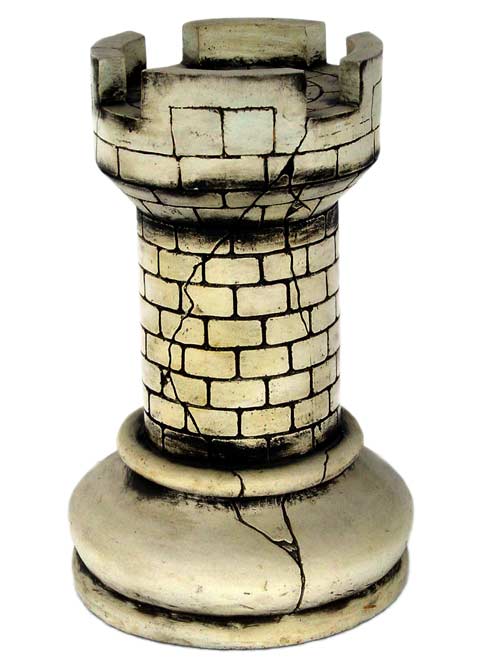
Ivory tower rook piece from a chess setMy undergraduate degree is in Cultural Anthropology, and during my junior year of college an Anthropologist told us that the education we were receiving would very likely distance us from the people we would eventually work with. (Never mind any cultural or religious or economic differences!) I’ve carried that warning in the back of my mind ever since. Now I have a Masters of Divinity and I’m working on a Doctor of Ministry degree and widening the distance whether I want to or not. The problem is, I’m realizing more and more that the distance is not just between myself and the people I work with; it’s frequently between myself and the people closest to me … and sometimes I feel like crying.

Three days a week I’m surrounded by people who have high expectations for themselves and others, who have respect for people who are not like “us.” Three days a week I’m in the company of people who believe in nonviolence and interfaith dialogue. Outside the ivory tower of academia–and specifically religious academia–I often encounter people who think telling ethnic jokes and making fun of people with disabilities (in private, at least) is funny. I have to contend with people who think it’s okay to denigrate any religious beliefs that aren’t close enough to their own.

So what’s a “nice,” left-of-progressive, lady preacher to do? I know, I know—I should be prophetic and call people to account for their ignorance and insensitivity. I find that very difficult. I don’t want to be seen as the humorless religious fanatic, or jeered for being uber “politically correct.” I don’t want to be the “bitch” that spoils everybody’s fun. I don’t want people I love to avoid me. Yep–it’s all about me. And that’s the problem.

The disease of the self runs through my blood
It’s a cancer fatal to the soul
Every attempt on my behalf has failed
To bring the sickness under control [1]

I want to do the right thing. I want to stand up for justice. Really–I do. I also want to be compassionate, humble, nonjudgmental. So I sympathize with the Apostle Paul, who was moved to write, “For I do not do the good I want, but the evil I do not want is what I do.” [2] It’s a sin of commission and omission. I stand on the battlement of the ivory tower, knees shaking, trying NOT to look down… and paralyzed by fear. I want to do the right thing; I’m just not sure what the “right thing” is.

_____________________________________________________________

[1] Charlie Peacock. “In the Light.” Copyright 1991, Sparrow Records.
[2] Romans 7:19, RSV

Feeding the Beast

Yellowstone Wolf Collaring

Later this month the United States will observe the anniversary of the tragic September 11, 2001 attack that killed almost 3,000 people in New York , Pennsylvania, and Washington D.C. in a single day, a horror that continues ten years later because of the resulting PTSD, suicides, wars. It probably isn’t a uniquely American phenomenon, but we sure do like to celebrate violence – Independence Day; Memorial Day, which began as Decoration Day; Veterans’ Day, which was originally known as Armistice Day; and most recently, Patriot Day.

Oh, sure, some people will argue that it isn’t war and violence we’re celebrating: we’re commemorating the end of war, honoring the bravery and sacrifice of our troops, remembering the victims, celebrating our hard-earned freedom as Americans. I recognize some legitimacy in those claims, but I’m not so sure that we’re really doing anything more than feeding the beast when we observe national holidays with fireworks, flags, and parades of people in military uniforms. Of course, it isn’t just holidays that contribute to our culture of violence.

Media violence is frequently cited as the source of the problem. Really? Is it the case that life is imitating art or are movies, television, and music just the mirror that illuminates the ugliness that surrounds us? I don’t have an answer; I’m just asking the question.

War, rape, murder, torture – those are impossible to ignore, but smaller acts of violence swirl around us like a swarm of dust devils and are so common that they frequently go unnoticed, sometimes even by the target. According to Matthew’s gospel, Jesus said:

But I say to you that everyone who is angry with their brother or sister will be in danger of judgment. If they say to their brother or sister, ‘You idiot,’ they will be in danger of being condemned by the governing council. And if they say, ‘You fool,’ they will be in danger of fiery hell. [1]

It may be a cliché but it’s true nonetheless: words hurt. Rage, gossip, constant criticism, and name-calling are all acts of psychic and spiritual violence. In his 1996 book Words That Hurt, Words That Heal, Rabbi Joseph Telushkin writes, “Words said about us define our place in the world.” [2] Anything – anything –that degrades or devalues any part of Creation is violence, and any act of violence is sin because it creates (or at the very least widens) a separation between creature and Creator.

There is a Cherokee legend about two wolves, one good and one evil, that battle within each person. Which wolf wins? “The one you feed.” [3] I believe that the only people who want to do harm and those who have, themselves, been harmed in some way. We will only end the cycle of violence and abuse that afflicts the world when we stop feeding the beast.
_____________________________________________________________

[1] Matt. 5:22 Common English Bible.
[2] Telushkin, Joseph. Words that Hurt, Words that Heal. (New York: William Morrow, 1996), 4.
[3] Two versions of this tale can be found on the website First People, http://www.firstpeople.us/FP-Html-Legends/TwoWolves-Cherokee.html.

A Word is a Word is a Word

Forewarning: This post may seem unbecoming coming from clergy, but we are not your grandmother’s clergy! Do not fear, be brave!

The title of this blog may seem familiar to some of you. Not because you have heard it before, but because it sounds like Gertrude Stein’s “a rose is a rose is a rose”. That is intentional. This line of Stein’s verse is famous in American/Modern poetry because it points out the hypocrisy of language in the modern and post modern era. In fact, Stein’s words want us to see that so much of what we make words to express is sometimes not what we mean at all and sometimes exactly what we mean. Hmmm…what? Yes in the modern and post-modern world we live with words that both say exactly what they mean and not at all what they mean–all at the same time. And we wonder why our society sometimes seems so crazy! We seem to live in a world that wants to reject the basic theological and religious principles of the “both / and” while at the same time society promotes dual meanings of so many things.

We used to live in a world where the social rules were clear and people more or less knew what was expected of them. The black and white time of knowing what was acceptable when and where–is no more, yes even before I was born we moved into the Technicolor age! The time when people both understood that others expected to be treated according to the Golden Rule and one might expect to be treated according to the Golden Rule is gone. We do not even know what to expect of our own language in such a twisted age. Or do we?

This has all been on my mind as I serve as a chaplain in multiple places. We often forget that our world is now in color rather than black or white. In some cases it is more shocking for those I meet to realize that I am an honest authentic human being then it is for them to accept that I am female and clergy! Several times in the past few months I have over heard people speaking plainly and honestly, letting the four letter words fly. But then they suddenly realize I am near by and I hear the refrain “We gotta be good, the chaplain is here”. Nothing makes me laugh more! Really, are they afraid of me? But inside it makes me sad for those I serve with and for myself. It makes me sad that individuals feel a need to censor their most authentic self as unfitting to being in the presence of those human beings who have been set aside as God’s servants. Occasionally in fulfilling priestly duties clergy may fulfill the role of the representative of God for portions of the liturgy, but clergy people are not God! Confusing clergy, in all they do, with actual representatives of God can be catastrophic, as I learned in my grandfather’s church.

In my years of chaplaincy, I have had my share of encounters in which I have heard many a swear word, not in a profane way but in an honest–there are no other words for this kind of way! I learned much and walked away from a particular encounter with great respect for an individual who in the face of power was authentically and piercingly honest even when every other word that had to be said was a swear word. I mean, when you get to down to the bones of it isn’t God, God’self a rather honestly authentic but there are no other words to describe it kind of being?

So, please do not feel the need to censor yourself around me. Really I am big woman, I can deal with it and I am not gonna judge anyone’s swearing (I feel differently about language that defames or degrades human beings). There is no need to pretend you don’t use the four letter words simply because I am around. I like four letter words–they can be theological. After all have you ever heard clergy talk amongst themselves when they think no one is listening? Besides, LOVE, is also a four letter word. Let’s be real, a word is a word, is a word. Except for that one Word from which all others spring.

Happy Eid ul Fitr!

Happy Eid ul Fitr everyone! Yes, this is the day that Muslims around the world celebrate the end of the holy month of Ramadan. Ramadan is a month of fasting from sun up to sun down and making alms to the poor. The Interfaith Calendar says Eid ul Fitr is “a festival of thanksgiving to Allah for enjoying the month of Ramadan. It involves wearing finest clothing, saying prayers, and fostering understanding with other religions.” (accessed August 31, 2011).

Fostering understanding between the world’s religions is something we at WWSIC can really support.

And, yes, as a chaplain Eid ul Fitr is one of those holidays a chaplain serving people of all faiths and no faiths needs to know about… So…

Blessings this Holy Day and may the God of Many Names Bless your feast this day and all days!

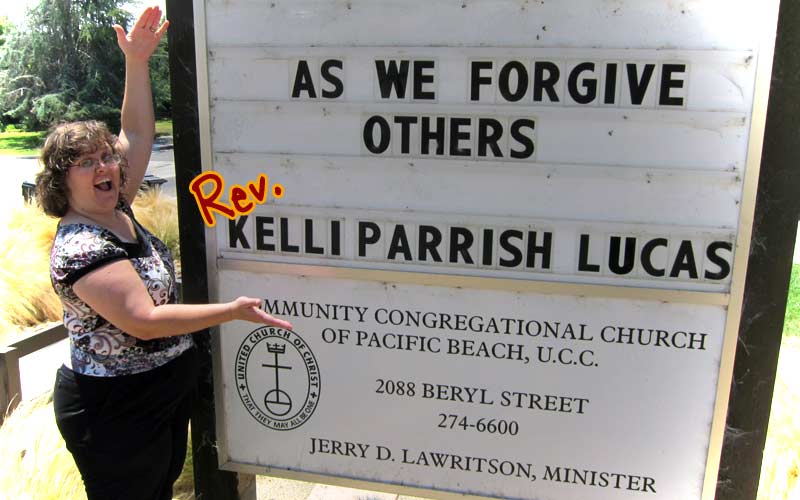
As We Forgive Others—Rev. Kelli

Rev. Kelli mugging at the marquee at church with her name on with "rev." painted in after the fact

Uh, that's "Rev." if you please...

Kelli just delivered her first sermon since being ordained in May. It was delivered at CCCPB on August 14th. Since it ran past YouTube’s 15 minute rule, it had to be cut into two, and at least at the time of posting, this is how we gotta do it. Back at YouTube, you can view it as a slightly more graceful playlist that will auto play in series.

Rev. Kelli looks at food insecurity in the time Joseph, a Hebrew in Egypt, and the dire situation in Africa (and lots of places) today, and introduces the UCC Mission 1 campaign.