Ordination!

You can call her “Rev.” now.

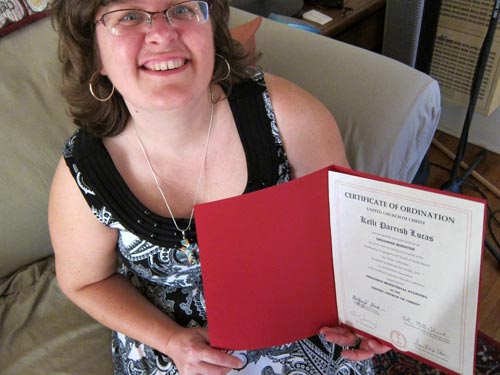
Kelli beaming with ordination certificate finally in hand.

One relieved girl!

We just got back from the festivities following Kelli’s ordination today—long awaited, and taking just a bit over six years since she was accepted to seminary in April 2005. You can imagine this is a huge victory to claim. After our dinner, she was wiped out, so here I am, ever the journalist for the family…

Held at the church where we both were born into and where we have been baptized and married in, this is a particularly notable day in the history of CCCPB, as Kelli is the only of that congregation to have started so young and followed the long and winding path of faith and formation, all the way to this point.

In attendance were members of CCCPB, Mission Hills UCC (where she interned), other churches in the local UCC Association, friends from United Methodist, Disciples of Christ, Unitarian Universalist, and Presbyterian worlds. Friends from the world of chaplaincy, poetry, and plain ol’ good friends were there to support her too. (A few of the ladies might not know it but they might be contributors to this very site, once the dust settles here!)

For the week, Kelli’s mom Kay Taylor was in town, and brought her autoharp with her. She sang a heart melting rendition of God’s Eye is on the Sparrow for the offertory in the ordination service. We just happened to have a mic on her too!

Over 100 images from the day are now on my Facebook page, and concurrent with all this, we are starting the WomenWhoSpeakInChurch page on Facebook too.

To save you a trip to YouTube, check these out:

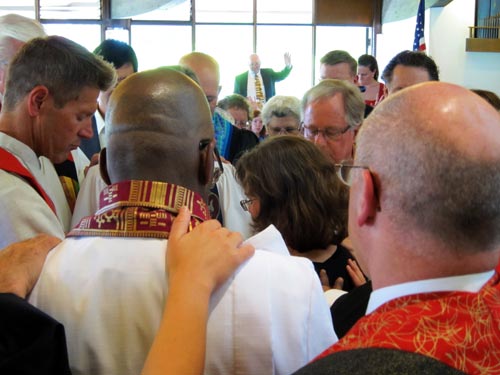
Kelli in the midst of the clergy laying hands.

Laying on of hands, clergy and lay folks

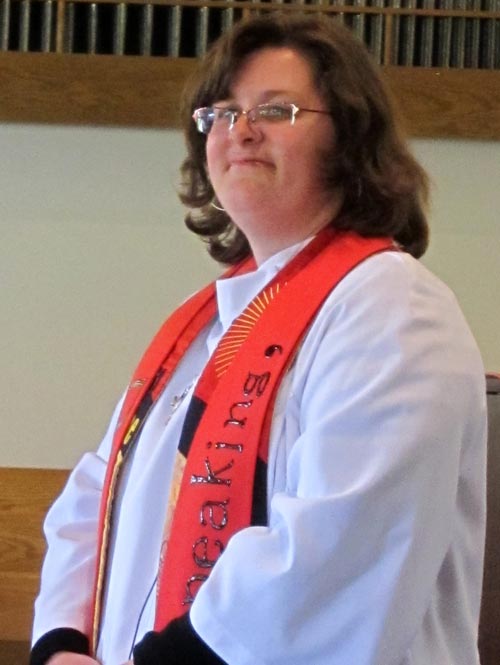
Kelli looking sharp with robe and stole.

Kelli after being robed, and having just distributed the bread in her first communion

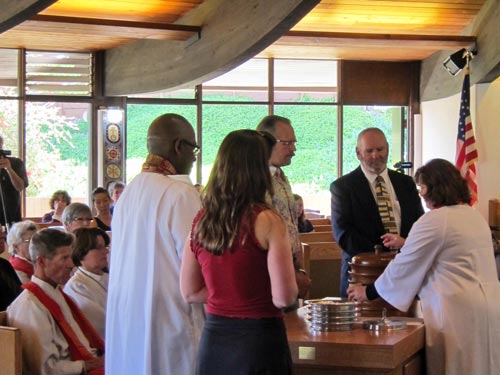
Kelli serving communion for the first time.

Kelli serving the wine at her first communion as "the Rev."

Off to dinner with MHUCC friends and mama Kay.

Kelli and a number of us from Mission Hills Young Adults, out to dinner to celebrate

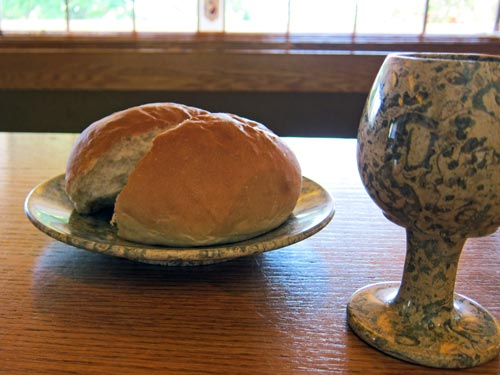
Kelli's new chalice and plate for communion

Kelli's new chalice and plate for communion, made from solid stone from Pakistan

Thanks to Phil, Tara, Margie, and Amanda for heroic help.

An Easter Treat!

Had to share this for Holy Week!
The Women Preached it First, UCC

Holding Fast to God: Lent 4

There is so much richness in the lectionary for this week that it is hard to know where to start. What strikes me in the texts for the third week is that both Psalm 23 and the story of the Man Born Blind (John 9:1-41) have very little to do with one another and yet in the end they both point us towards holding fast on to God even when that seems irrational and all else is seeming lost. In the depths of these texts I sense that there is a calm center—the welcoming of God, Godself—in the midst of the chaos that surrounds the central character of each text.

I doubt I will ever forget a seminary afternoon I spent in Psalms class taught by Dr. Kristin De Troyer, an amazing scholar and teacher! This particular afternoon we were looking at Psalm 23, and going through it line by line examining the poetic stress and how the word pairs worked to enhance the meaning of the text both in translation and in Hebrew. A text that has almost come to seem cliché jumped out at me. As Professor De Troyer took us through this text it became clear that it was not only not a simple text, but also that it was far from the pastoral text the images depict. This is perhaps one of the most familiar texts in the Western world. “The Lord is my shepherd…” The words themselves are so calming to even think. (Although I must admit that after encountering the Vicar of Dibley series I found myself giggling every time I heard the opening of this Psalm because it had become such a lead into comedy for me. But I digress…) However, as I think back to that day in seminary, in the long warm conference room, I think of how sad it is to me that this text is so misunderstood and so misused. As the professor unpacked the word pairings of the text and went through the images of the text with us in view of its ancient origins, it came alive for me in new ways. Professor De Troyer led us on a discovery that this text is one of flight and seeking refuge. The table which God is said to prepare in this text is not just a meal table, not a welcome table but rather the alter in the tremble where one might seek refuge—the one place that a hunted or chased person may find refuge, for no army and no official could lawfully seize a person who had to the ram’s horn on the altar of God. And not only is the text one of safety for the person in peril, but it is also one of vindication.

I thought on that day, how strange it is to use the text of Psalm 23 as a text for the time nearing death. It seems to me that the context of death is the one in which Psalm 23 is often used. I remember thinking to myself on that day in seminary, that I would uphold the integrity of the poetics of the text and not use it in the context of death because in my class I was learning that really the text is more appropriate to the situation of the immigrant running from immigration officials than it is for the death bed! But such can be the arrogance of pure academic scholarship mixed with inexperience. As a chaplain I quickly learned that despite the meanings unearthed by the poetics of this text, the fact that this text brings meaning and comfort to people in various situations but particularly at time of great illness and approaching/at death cannot be ignored. As a poet, it first pained me to use this text in the context of illness/death. However as chaplain—and even as a poet—there is something more important than intent to tend to. There is always at the heart of all matters the meaning and care for others that must be considered. In my experience as a chaplain I have learned that even people who are not religiously affiliated will ask for Psalm 23 to be read at time of death. It has become easy, both for the scholar and the poet within, to allow my poet self to read Psalm 23 in the context of illness/death. This is true not only because it is caring to read something that has meaning to those who request it at these times, but also it is true because of the death/dying process itself. The death/dying process itself is one of letting go of all we love—be it things, people, places, and how we identify ourselves. In this sense the death/dying process is one of seeking refuge in the only place we have left to turn when all else falls away—God, or our understanding of the sacred. In some small way Psalm 23—which is really more about refuge from the world than death—is in a way one of the perfect and most simple texts to turn to for reassurance, whenever we need it, and often that is the time close to dying.

The paradox of this struck me this week as I taught Sunday School to the four and five year olds—and Psalm 23 was the text for the week. Here Psalm 23 was in no way connected to ideas of death and dying, there was no thought given the notion of fleeing for one’s life or seeking refuge, but rather the image of the shepherd became the focal point for discussions of care, compassion, and God’s love for us. It was a bit odd I admit for the hospice chaplain to be teaching Psalm 23 to a group who, God willing, will long outlive me. But it was also a moment in which I found wholeness. For, as we first learn Psalm 23 (particularly if we know what a sheep is only though books and we have to learn what a shepherd is) we learn that God is present with us at all times and that God cares for us through others who feed and tend to us when we are sick. There is omnipresence, we are never alone. God holds fast to us so we may hold fast to God.

By now you may be thinking that at the outset I mentioned this was also the case in the gospel for this week, in the story of the man born blind. Well it is. This is one of the “healing stories” in the gospel, and generally I find these complicated and problematic. This story from the ninth chapter of the Gospel of John, however, is one that important and liberating to a point. It is in this text that Jesus clarifies for all those around that sin is not the cause of disability for Jesus says “Neither this man nor his parents sinned, he was born blind so that God’s works might be revealed through him” (John 9:3). This is very liberating to people with disabilities because it separates sin from disability, in the words of Jesus, and long before science would show this to be true. Rev. Dr. Kathy Black points out that this healing story is different than others found in the gospels because whereas other healing stories end with the person with disabilities being integrated back in the community, in the case of the man born blind Jesus’ healing of the man results in his being expelled from the community. (A Healing Homiletic: Preaching and Disability, Abington: Nashville, 1996, 72-73.) The blind man’s encounter with Jesus and his healing lead to controversy within his faith community. The man not only proclaims the work of Jesus to his community but he also calls Jesus a prophet! Like a good shepherd, Jesus seeks out the man when the community expels him and then the newly-sighted man accepts Jesus as the Son of Man. The healed man held fast to his experience of God, even when he faced losing his community because of it, and Jesus came to him there.

Whether we struggle with fault/blame, change, leaving, or how to approach the other this Lenten season let us hold fast to God with the hope that God holds fast to us as well.

Others: Lent 3

The Lectionary reading for the third week of Lent is John 4:4-42. It is the text about the Samaritan Woman at the well and her conversation with Jesus.

I want to start by thanking my former seminary classmate, the Rev. Alison Rainey English, for posting this video on Facebook. I thought this was a breathtaking retelling of the text, so take a minute and watch it:

This video reminds me that the art of biblical story telling is one that I have much respect for. It is an art that seeks to tell a story in a new way, to reach out and shake the audience into new awareness of what is being said, much like poetry does. Perhaps this is why this particular video strikes me. (There are other similar portrayals of this text.) It makes me take notice of the woman at the well and her story that became so much of the encounter with Jesus.

I have been pondering this text in part becuase it may be used in a worship service that I am helping to plan for a conference this summer. It is indeed a rich text, perhaps one that begs for the liturgical arts be present as witnesses to it. But this text is also one that comes up time and again when we talk about crossing social boundaries to invite others to our faith and to include them in worship. Here is a woman possibly outcast in her own society, certainly a woman who has seen her share of trouble, who is also a member of outcast group talking with Jesus. Jesus who does not shy away from her but engages in dialogue with her. Gail R. O’Day makes an interesting point by naming that while this woman is often seen in some immoral light because she has had five husbands Jesus does not condemn her for this but rather allows her to become an apostle by telling her people about him (Gail R O’Day, “John” in The Women’s Bible Commentary, Westminster: Louisville, 1992, 296). The truth is we don’t know much about the history of this woman before she meets Jesus. She may have been repeatedly widowed or part of a non-Jewish marriage that was based simply on a contract that could be exited at will–but we know what she does when she meets Jesus, that she unlike many in the gospels recognize Jesus as the Messiah, and we know she acts as an apostle after meeting Jesus.

It is precisely the actions of this woman in contrast to those of the disciples that strike me as a Lenten nugget in this text. This woman is outcast as a woman, outcast as a Samaritan, outcast by having a personal history; this woman is not only welcomed by Jesus but takes it upon herself to become an apostle. This Lenten season we have thought about fault and sin, about leaving and change, and now we are faced with a text that appears to lift up a person who would not be lifted up as a religious example as one who sees and seeks the truth. The woman at the well is the other who only seeks truth and love while being denied both by society. But all that changes when she meets Jesus. For Jesus reveals the truth to her, a truth that sends her back into her community, where she might to be listened to.

Could it be that the Lenten journey is one that not only calls us to examine our own actions but to also examine our social expectations to consider who we may be missing, and the truth they have to share, when we decide who is in and who is out according to our traditions? Jesus did not exclude persons; he always found a way to bring the other in. Perhaps this third week of Lent we are called to meditate on that part of the journey. The stories we could tell, and we still have so far to go!

Ordination

WOOOOHOOOOO! Kelli just got her ordination date: May 1, 2011! Long time in coming! Bravo, Kelli!

UCC Widening the Welcome Article

Widening the Welcome logoKelli’s article on Widening the Welcome has been republished in the Connecting Voices e-magazine. Connecting Voices has all sorts of great news of the happenings within the Southern California/Nevada Conference of the United Church of Christ.

Read the Connecting Voices article here. Also, watch for more such material to appear here on WWSIC in coming months.

Fault: Lent 1

Lent has taken many forms over the years. In the early Christian Church Lent was time of preparation for baptism. Lent has also traditionally been a time of penitence. To this day many Christian communities view Lent as a season of personal reflection on how to live up to Christian ideals. There seems to be a current shift in the observances of Lent with many Christians now using this time to intentionally take up spiritual practices and draw closer to God. Whether drawing closer to God, engaging in personal reflections, observing the practice of penitence, or preparing for new life, the scriptures in the Bible seem to be one of the foundations to which we, as Christians, turn during this season. For this reason, I will be attempting through out this Lenten season to offer some scriptural reflections on this blog and these reflections will be based on the Revised Common Lectionary (RCL) or feminist lectionary Women’s Stories from Scripture for Sundays and Festivals: Remembering the Women by J. Frank Henderson, which also follows the RCL while offering passages reflecting the lives of biblical women to be used when the RCL does not.

Perhaps I should not be surprised that the scripture for the first week of Lent, the season of repentance and reflecting on sins, is Genesis 2:15-17; 3:1-7 about Eve and Adam eating of the Tree of Knowledge in the Garden of Eden. It is a text often pointed to as proof of “Original Sin,” the “untrustworthy” or “evil” nature of women. If you are unfamiliar with this passage or would like to refresh your reading of the text you may do so here. It is a text that has long affected the relationships of men and women, particularly in the realm of religious understanding and authority. But what does it say to us in Lent, about penitence, about drawing closer to God, about living the Christian life today?

I recently had occasion to re watch an episode of Bill Moyer’s wonderful PBS series Genesis in which Moyers, himself a pastor, gathers a variety of thinkers, artisans, scholars, and theologians to reflect on the major stories in the Book of Genesis. One of the Genesis episodes named “Temptation” addresses the Genesis passage about Adam, Eve, and the Tree of Knowledge. (And yes I must admit spending an hour listening to scholars discuss this was heavenly.) I mention this episode because in rewatching it I was particularly struck by two issues in the Adam and Eve text that I don’t think we often talk critically about: fault and relationship.

So often we approach this text with our tendency to idealize and analyze, and I wonder if in doing so we miss something important. We often imagine Adam and Eve in the garden with all their needs meet and without much worry. Perhaps it was ideal, certainly having all my needs met so I can simply be sounds ideal. But Adam and Eve were human. I have not lived as long as some people have but it does seem to me that one of the traits of our humanity is that if things get too easy we become bored; when we have too few challenges we wonder about new things, we strive to do something new, something to change the status quo although we always hope it will change for the better. It seems that some of that is a foot in this text from Genesis. Eve acts. If we ponder that without judgment for just a minute (go on, I dare you!) we see something different emerging from this. Steven Mitchell, in the Genesis episode comments that Eve is “the one who makes everything happen, who acts out of love for God, if God is wisdom.” (Genesis: a Living Conversation, New York: Doubleday 1996, 47.) In the text the serpent tells Eve “your eyes will be opened, and you will be like God knowing good and evil.” It is in some ways Eve’s eating of the fruit was a very Lenten act for it was an act to become closer to God, to “be like God”.

Yet, seeking to be closer to God can often change things in unforeseen ways. In the Genesis story, Eve took a human risk to do something different in order to become closer to God. But things did not work out the way Eve expected. There is in the text evidence that God told Adam not to eat of the Tree of Knowledge before Eve was a part of the story, Eve may not have had this command directed at her. Nevertheless, whether Eve defied God, as is often said of this text, or whether Eve was acting out of innocence (which seems a closer reading of the text) Eve’s eating of the fruit changes the relationships in the Garden. In Genesis, prior to this episode God is portrayed as walking in the Garden with Adam and Eve. Yet that changes after the eating of the fruit. In the Genesis episode Marianne Meye Thompson makes the point that after the fruit is eaten “they clothe themselves, as if to hide from each other. And they also hide from God.” (Genesis, 52). The text then is about human changes. Changes in human ingenuity, changes in human spirituality, changes in relationships between man and woman as well as between humans and God.

Our text seems to indicate that changes in ourselves also lead to changes in our relationships with others. One of the other things I have noticed about humans is that we don’t like change. Adam very much portrays that aspect of human nature in this story. For when God asks why they are hiding, why they know they are naked, Adam explains that Eve gave him the fruit to eat. God does not fall for it. God does not tell the pair that everything is going to be okay. Rather, God acknowledges the change in all their relationships that will take place, perhaps because of their acts, but also because of the change that has taken place in the man and woman themselves. Not only is change never easy, but in this case the change also brings about suffering. In the Genesis episode Elaine Pagles says of this text that “it insists that suffering has to be somebody’s fault.” (Genesis, 50.) As Christians we live with a tradition that (perhaps not originally) for many centuries has taught that this is a text that tells of how a woman brought sin into the world and how man was given power over her. Sin is a form of suffering. And yes this is a text that speaks to how suffering came about in the world. But woman did not bring suffering into the world. The wisdom of acknowledging suffering existed in the Garden, locked in the Tree of Knowledge, before Eve was ever there. Once that knowledge of suffering, once innocence, came out it could not be put back. There was change; change that required Adam and Eve change their relationships to one another. Once change is proclaimed, it is not always a pronouncement about the way things will be forever. We know this. As Christians, it becomes part of our being. For our teacher Jesus was always challenging the ways people related to one another, turning relationships upside down, inviting the outcasts—even the outcasts from the Garden—back in. Change is part of the Good News!

So, welcome to Lent. Whatever you seek to do this season whether penitence for sins or drawing closer to God through spiritual practices, be aware that such changes can have profound effects on all your relationships. And may God be with you on the journey.
The Three Women

I am not a writer, but there are those times when I feel it necessary to write, if only so I don’t forget the significance of events. Today I experienced something that was so refreshing and meaningful I needed to write about it, as it confirmed in a new way something I have known for some time. I am not a ‘spring person,’ but for some reason this spring I have been enjoying all the pastels and flowers in spite of myself. I also feel I experienced Easter differently than in years past. I am still not sure as to all the reasons as to why, but I am willing to think about them for as long as I need to. I think one thing I have paid more attention to this year is the idea of resurrection and the promise of new life that it offers. For me, as many of you know over the past few years I have wavered between mixed emotions regarding my call into ministry. Anger, excitement, disappointment, discontent, and exhilaration are just a few of the vast numbers of emotions I have experienced. It is interesting to note these emotions are and were usually entwined with a church community; not necessarily my idea of God. I continue to work through them and have found my work as a chaplain to be a major part to my healing and integration. For me this year my resurrection was to consider a new way of serving and ministering as a female minister. I have needed for sometime to step out of the old bondage which was negative comments and negative gender roles that were not only oppressive, but unhealthy and damaging.

Today was just another example of how this work ‘heals’ me. I was making an initial visit with a patient who just came onto service. The patient was in his room and I stayed in the living room with the spouse. For almost two hours she talked about their marriage, their children, and their faith. She brought out pictures of them at their wedding and walked me through in pictures almost forty years of marriage and their life together. As the visit was coming to a close I went into the bedroom and found the patient no longer breathing, he had passed during our conversation.

I waited for the mortuary to arrive and to my surprise two women drove up in a van. The two women in the van and myself attended to the body, cleaning and getting ready for transfer. I couldn’t help but think about holy week and resurrection morning when the women came to the tomb. The women brought their spices and perfumes for proper burial. I can’t explain what I experienced in that room, but I know it was healing. I just finished a class in seminary on worship where worship was defined as “any encounter with God.” For me this experience was worship, a sobering realization of life, death, connection with God and humanity. To experience this with women who came there to work and to help create and bring dignity to the deceased and the family was amazing. At one point we all three looked at each other and just smiled one of us saying, “this was really nice, all us girls.” As we were leaving, the spouse of the patient kissed my cheek and said, “How lovely to have such wonderful girls looking after my husband, I know he is in caring hands.”

Late Night Chaplain Thoughts

in the gardenAlzheimer’s is a terrible disease. I often hear patients’ families explain it as losing their loved ones “over and over.” Along with strange and embarrassing behaviors there is the pain of the patient not remembering who you are. Often mother does not recognize daughter nor husband recognize wife. It’s an awful pain to see that someone with whom you have shared memories and your life and yet they can not recall your name.

I watched similar experiences happen to my grandmothers, although neither suffered with Alzheimer’s. My mother’s mother was a proud woman always concerned with me “acting like a lady.” I think I must have heard that gentle reminder (not so gently) enough times to equal the hairs on my head. (How does a lady act anyways? I digress. ) Watching her decline was something I did not really understand until I began working hospice. I still don’t think I fully understand it now. I remember thinking each time I saw her, and that was often enough, feeling as if I was seeing less of her or at least the real her. On the other hand,  you might say my dad’s mother was the ‘rebel’ of the family: the opinionated Democrat living amongst right-winged Republicans. This makes me laugh now. I remember her vitality shooting pool with her in the basement and catching lightning bugs in the backyard. As different as they were watching them slowly change was a terrible thing I can remember not wanting to be around them at all, because they were not the same people. I have to force myself to recall some of these memories and feelings as I think I have forgotten most of them on purpose. Not too long ago I was sitting with two friends enjoying a glass of wine and making homemade cookies when one asked me how much of my family history fuels my desire to work hospice; a job where impending death and debilitating illness is an every day occurrence. This is a question I am still considering.

Getting back to my original concept, Alzheimer’s is terrible and yet I find it fascinating. I am often amazed at what memories are remembered and which ones are forgotten. I know the clinical jargon short term verses long term memory, but for me as a chaplain I am more interested in what is imprinted in someone’s soul. What was encouraged? What was important? What changed them? Today I had a routine visit with an Alzheimer’s patient even in the midst of her paranoia and sundowners all I had to say or sing was “I come to the garden alone while the dew is still on the roses…” —and sure enough there she was joining me in the chorus. Listening to her voice, old and frail and completely off pitch, but there it was, the words perfectly remembered. After our duet was finished she took my hand and said “it was there sleeping and you woke it up.” During my moment of complete silence due to me simply not having the words to respond she stroked her grey hair and said “you know in the garden there is no confusion and total healing.”

Lent: Taking On; Letting Go

A couple of years ago I was challenged by a peer to “take on” rather than “let go” for Lent. Now, as a former Southern Baptist (which I was for almost 25 years) the idea of Lent has always been somewhat foreign to me. However, as I have gotten older and found my way into more of a liturgical community I have found that not only do I find great value in some of these observances, but I enjoy them and feel a sense of renewal in my spiritual life when practiced.

As a hospice chaplain, I can find myself in numerous crisis situations within a day. I may be called to a time of death, a family dispute or some other kind of crisis situation. I am expected to be present and in some way hopefully encourage and educate a family on how to cope. Living and working in crisis can change a person. Some become cynical or “rough around the edges” (I am talking about myself here); others withdraw and isolate from family and friends. Either way most people who are drawn to these kinds of working professions are drawn usually out of desire to “do good.” I am not talking negatively about a desire to do good, but I am suggesting we take caution and continually monitor our own desires.

While in seminary I was warned about the “clergy ego.” The idea that the pastor can do anything and should be able to do anything. I mean, after all, “I can do all things through him who gives me strength” (Phil 4:13). As I write this I am rolling my eyes, but that is for another blog on another day. I want to hold this issue of the clergy ego for just a second and discuss how it relates to female clergy. Let’s be honest: women in our culture may have the vote and may be in the work place, but in some ways are still considered second class citizens. Now, please do not think me as a raging feminist who spends her free time burning her bras; in all reality I am very much an egalitarian. I am just pointing out that women are most of the time the caregivers. Think about it who fixes breakfast, who packs the lunches, who does the laundry, the dishes, and who keeps the family calendar, etc. We are taught to “take care” and this transcends our homes, community and work place. So where is the “ego” in this? Are women taught to have ego? Should women even think about ego, or should we just do. Ok, I’ll stop! :0)

I know what you are thinking, how does this relate to Lent? Well, getting back to the challenge of my peer, this year I have decided once again to “take on” for Lent. I am taking on self care of my whole self: mind, body and spirit. Below is a parable I found a few years ago (if I knew who wrote it I would give them credit), but I love this parable. For me it speaks to the gamble we take when we neglect ourselves while taking care of others.

ENJOY…

The Little Girl and the Ungrateful Snake

A young girl was trudging along a mountain path, trying to reach her grandmother’s house. It was bitter cold, and the wind cut like a knife. When she was within sight of her destination, she heard a rustle at her feet.
Looking down, she saw a snake. Before she could move, the snake spoke to her. He said, “I am about to die. It is too cold for me down here, and I am freezing. There is no food in these mountains, and I am starving. Please put me in your basket so I can rest and please take me with you.”
“No,” replied the girl. “I know your kind. You are a rattlesnake. If I pick you up, you will bite me, and your bite is poisonous.”
“No, no,” said the snake. “If you help me, you will be my best friend. I will treat you differently.”
The little girl sat down on a rock for a moment to rest and think things over. She looked at the beautiful markings on the snake and had to admit that it was the most beautiful snake she had ever seen.
Suddenly, she said, “I believe you. I will save you. All living things deserve to be treated with kindness.”
The little girl reached over, picked up the snake gently placing him in her basket and preceded toward her grandmother’s house.
A few minutes later the snake spoke to her again. “Thank you” he said “but if it’s not too much to ask I am cold, can you put me in your coat pocket.” The little girl thought for a moment and decided to grant his request.
Upon reaching her grandmother’s cottage she discovered although her grandmother wasn’t home, there was a fire and plenty of food. The snake popped out from her pocket, “Oh, please little girl, I am still so very cold could you place me in front of the fire? The little girl did what he asked. She then went into the kitchen to make herself a plate of food.
“I know I have asked a lot from you” he said, “but if I could please have one more thing.” What is that she asked, “Could I please have a saucer of milk?” As she leaned over he lunged at her, biting her on the hand.
“How could you do this to me?” she cried. “You promised that you would not bite me if I would protect you from the bitter cold.”
The snake hissed, “You knew what I was when you picked me up,” and slithered away.

May all of us remember the value of self care especially my female clergy friends. Thanks for all you do!