The following article was prepared for a seminary class in 2007.
Eschatology is the study of human thoughts concerning what is “last”; translated from the Greek, eschatology means study of the last (1). The question this raises for me is: the last what? Theologically speaking, eschatology is commonly thought to refer to culmination of history or the end of time. In Christianity, eschatology is often associated with the coming of God’s Kingdom on Earth as it is in Heaven, and the return of Christ. For religions that place emphasis on the historical patterns of time, such as the Abrahamic religions, eschatology can serve as a “hope [that] locates the ultimate achievement of the ideal in a final era of human history” (2). Ultimately, eschatology leads us to reflect upon what it is that we consider to be ideal, and perhaps essential to the human experience in relation to both the world in which we reside, and the divinity in which we live and have our being. The exploration I will seek to engage in this brief essay is how some feminist theologians approach this notion of eschatology. What are the last things that feminist theologians hope for? What, ultimately, do feminist theologies hope for?
Traditionally, eschatology has brought to mind the Battle of Armageddon, and the notion of some who are cosmically crowned by a heavenly king, while others are sentenced to eternal torture. These images themselves smack of patriarchy with all its war, hierarchy, and threats to non-conformers. Feminist theologians, starting from the ground of their own experience and carrying with them a commitment to non-hierarchical structures, have tended to view eschatology in a different light, and use a different vocabulary in reference to it. Justice is one word that seems common in feminist discussions and visions of the eschaton.
Building on a tradition that emphasizes history in its concept of world completion, Rosemary Radford Ruether draws an eschatological vision based on the jubilee notion found in the Jewish and Christian scriptures. She writes that “[i]n the Jubilee tradition this is thought of not as one ‘great cycle’ defining history from a beginning to an end but as a series of revolutionary transformations that continually return to certain starting points” (3). The idea of jubilee is that each family has possession of the land they need to provide for their means, and that individuals are free to benefit from the land. It is an idea that all have what they need to survive; this is the starting point to which justice returns in the world. An eschatological vision based on this would have to assume an ongoing process of justice in which injustices are righted and the necessary means of life restored to all persons on a regular basis. Ruether sees this “concept of social change as a conversion to the center, conversion to the earth and each other, rather than flight into an unrealizable future.” (4). It is ultimately justice among persons in community, and all the responsibility that entails, that Ruether advocates as an eschatological hope. It is a hope in which the ultimate meaning of humanity comes in the form of personal responsibility and a communal justice that encompasses all the earth. This is justice.
Justice—and the struggle for it—is also a primary (if not ultimate) goal for other feminist theologians. Judith Plaskow, as a Jewish feminist theologian, is even bolder in this pursuit writing of “the relationship between spirituality and politics as a theological issue” (5). The politics of which Plaskow speaks is social justice. The connection of politics and spirituality is paramount to Plaskow because drawing upon her Jewish tradition she reminds us “the prophets affirm that the forms of worship are meaningless in the absence of social justice” (6). Thus the Jewish tradition, and the Christian tradition that stands upon it, demands the not just the uplifting of but the reality of social justice as a prerequisite for worship. It is only through social justice that humanity can reach toward “new understandings of divinity” (7). Eschatology for Plaskow seems to be a reaching out for and bringing in those persons society marginalizes and considers to be “last.” This requires a political understanding and interaction with the world, because, “[w]hen spirituality is understood from a feminist perspective—not in otherworld terms, but as the fullness of our relationships with ourselves, others and God—it can not possibly be detached from the conditions of our existence.” (8).
Experience as the basis for the formation of theological and spiritual reflection is at the heart of Ada Maria Isasi-Diaz’s Mujerista Theology. Isasi-Diaz’s eschatology is one in which, like Plaskow’s, there is an expectation that the establishment of justice will also bring with it the establishment of the kin-dom (sic). She writes that “[t]he main obstacle to the unfolding of the kin-dom is the alienation from each other experienced by all in and through the oppressive societal categories and structures that cause and sustain oppression.” (9). Thus, the kin-dom exists when oppression is banished and liberation established. The eschatology here is, again, a function of human interactions. As a Latina, Iassi-Diaz not only writes her theology from a feminist perspective, but also from a perspective that seeks liberation, culturally from within and racially from without. In this effort to organize for the liberation of the poor, of women, and of Latinas/os, Isasi-Diaz’s theology puts emphasis on the practical steps of how to build a community that will bring about the kin-dom. Such practicality is based on her emphasis that change will only begin when the oppressed achieve “conscientization” (10) of their situation and the oppressors are able to find their way to being in dialogical solidarity (11) and mutuality in which the oppressors come to understand the oppressed (12). From the perspective of Isasi-Diaz’s theology, it is justice between the people, with power and those without, that becomes the determining factor of when the ultimate hopes of humanity are achieved . Yet, this justice is “ever changing” based on the lived realities of people’s real experiences (13).
There are many ways in which eschatology has been and can be viewed. Often when we look to eschatology there seems to be little agreement about what the last things or times are. However, when we look at the question of what eschatology is from the feminist perspective there seems to be agreement, even across interfaith lines. Feminist theologies seem to agree that the eschaton, the ultimate hope for humanity, will be found only in the seeking and establishing of justice (Plaskow and Isasi-Diaz), or in the establishment of new ways of living in which seeks right relationships and justice among all inhabitants of the earth, human or not (Ruether). In terms of feminist theology, the eschaton is the realization of justice for and inclusion of those persons, and beings, whom are thought of last in the traditional hierarchies of power and control. There is also the implicit expectation of feminist theologians that this feminist eschatology includes roles and respect for women in the ecclesiastical / religious power structures.
***Endnotes
- Wikipedia contributors, “Eschatology,” Wikipedia, The Free Encyclopedia, http://en.wikipedia.org/w/index.php?title=Eschatology&oldid=175010037 (accessed December 4, 2007).
- Rosemary Radford Ruether, Sexism and God-Talk: Toward a Feminist Theology, (Boston: Beacon Press, 1993), 243.
- Ibid, 254.
- Ibid, 255-256.
- Judith Plaskow, Standing Again at Sinai: Judaism from a Feminist Perspective, (San Francsico: HarperSanFrancisco, 1990), 212.
- Ibid, 214.
- Ibid, 238.
- Ibid, 213.
- Ada Maria Isasi-Diaz, Mujerista Theology, (New York: Orbis, 1996) 90.
- Ibid, 94.
- Ibid, 97.
- Ibid, 89.
- Ibid, 116
Bibliography
- Isasi-Diaz, Ada Maria. Mujerista Theology. New York: Orbis, 1996.
- Plaskow, Judith. Standing Again at Sinai: Judaism from a Feminist Perspective. San Francisco: HarperSanFrancisco, 1990.
- Ruether, Rosemary Radford. Sexism and God-Talk: Toward a Feminist Theology. Boston: Beacon Press, 1993.
- Wikipedia contributors, “Eschatology,” Wikipedia, The Free Encyclopedia, [on-line] available from http://en.wikipedia.org/w/index.php?title=Eschatology&oldid=175010037, accessed December 4, 2007.
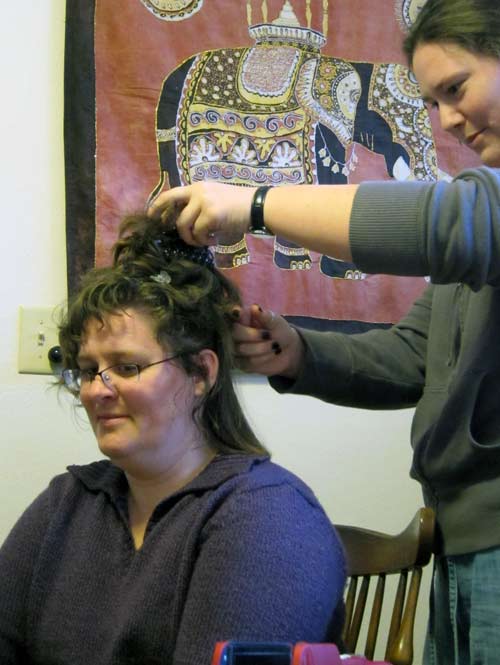 I am going to call it my “Vicar Do”! That is right, I am writing about ministry and hair style. I did not intend my new do to be an homage to the Vicar of Dibley, and I don’t think it is per se, but now that my hair is cut it does make me think of the Vicar in that hilarious series.
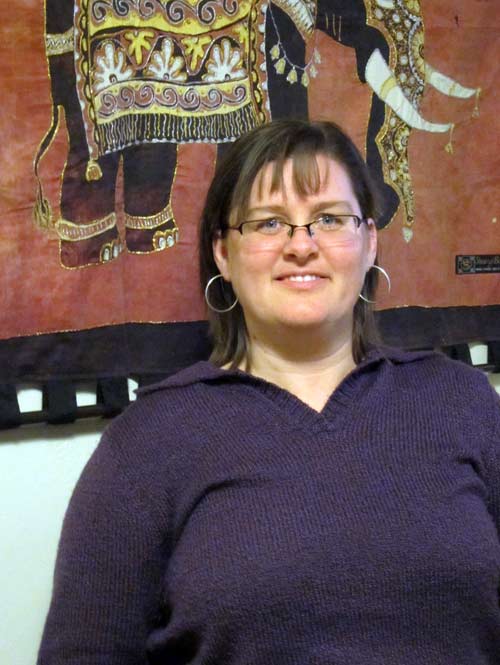 Of course, I consulted a friend with far more fashion sense than myself. (Fashion clearly was not one the gifts Spirit gave me, but I have so many others that I don’t care. It takes all of us, so as I understand it I can safely rely on others for help~see 1 Corinthians 12.) This fashion friend well understands my professional role, because she shares it. Of course I trust my hair stylist, too, who knows my vocation and profession. Her name is Bernice, the same name that the Acts of Pilate gives to the hemorrhaging woman in the Gospel of Luke. So I like to think of my hair stylist as a biblical woman when she is working on my hair. It helps me~have I mentioned that not only do I lack the fashion gene but that I just don’t care about things like ‘doing my hair’? BLAH~ but here it is a new hair style, which I think I like. And, yet, as I sit here no one I know has seen the new doo. And as all those question about how it works and the perceptions it gives off are swirling in my mind, unanswered. It strikes me that a life of faith is peppered with moments like this. When we hope for the best, even when we have no idea what may come~let alone how people will react. Perhaps I must just have faith that all shall be well. And if not I guess, in this case, it will grow out.
 Women Who Speak In Church